
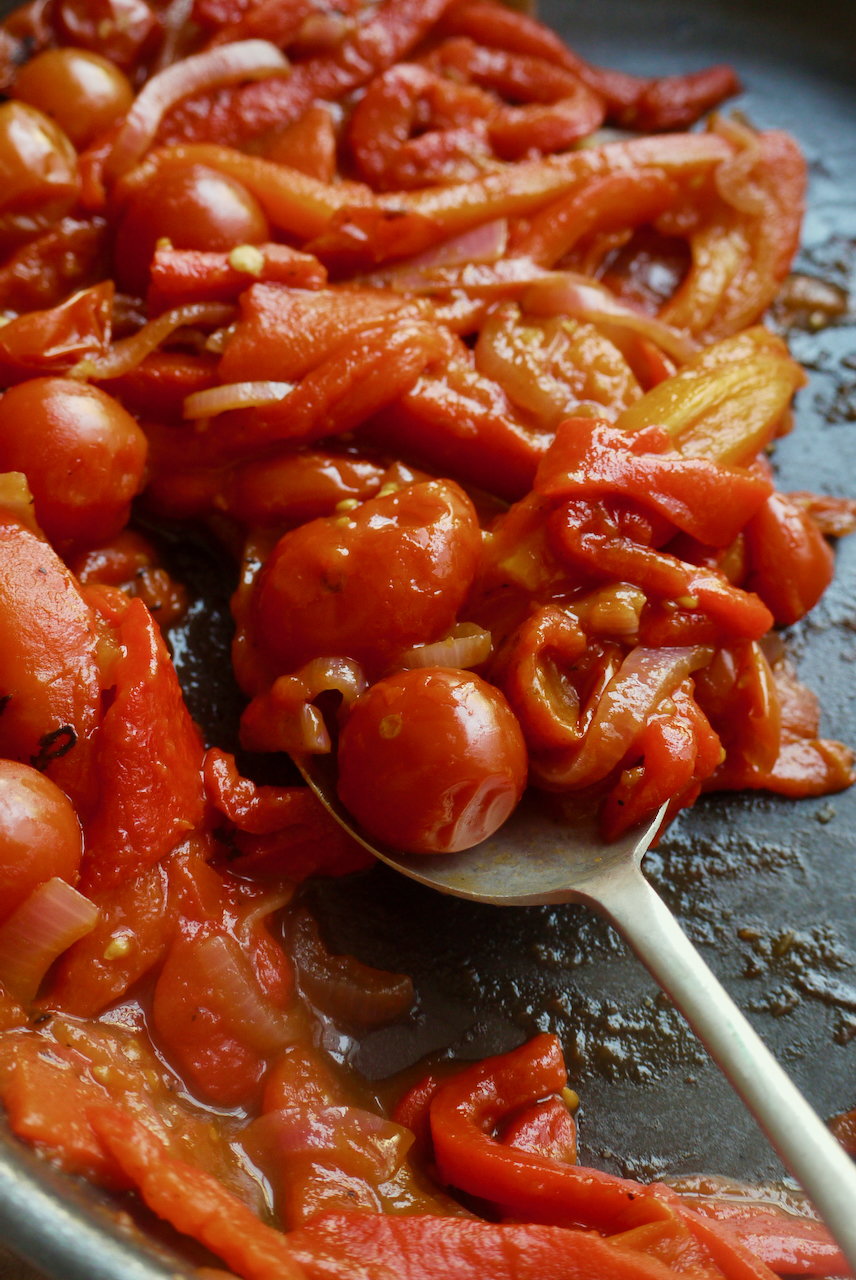
This blog has been a little quiet lately, mostly because my work-life balance has been abysmal, not something I’m happy about! Nor something I seem to be able to fix by pointing at myself in the mirror and yelling “work-life balance”. Curious. Nevertheless, here we are with a recipe my erstwhile Patreon patrons will recognise — though this is a slight adaptation rather than straight double-bounce. It’s that Basque classic pipérade, made pan-seasonal with a jar of roasted red peppers and canned cherry tomatoes. This makes it as much amenable to the most fruitless depths of winter as it does for those increasingly frequent disenchanting summers where the tomatoes are 20-denier, pale pink, and $15 a kilo. An enchanting dish, both in the haste of its method and the taste of the result, you’ll find reasons to cook this over and over, and with a few jars and cans in your pantry, you’ll have the means to do so, too.
Despite the pawprints I’ve left on this recipe, its sheer simplicity means it’s not that far removed from the traditional application — but the pre-softened peppers, with their waft of grill-smoke, lend all the flavour of something laboriously slow-cooked without any of the effort. In fact, I highly recommend keeping a couple of jars of roasted red peppers on you at all times because there’s only about 12 minutes each year where capsicums are even vaguely affordable. Red peppers, the sweetest of their sisters (the less said about the green ones, the better) have a grassy, almost earthy freshness that melts into the lemony-sweet tomatoes; the hard work of making their respective flesh tender and satiny has already been done for you, and around them forms a jammy-syrupy sauce, rich with garlic and the warmth of smoked paprika.
Pipérade is a dish defined by its potential as much as anything and in order to convey how good it is, I have to tell you all that it can be — bound only by your imagination and nearby resources. It’s frequently finished and enriched with a mixture of beaten eggs stirred in, but I’d like to use it as a base for shakshuka, with just-cooked eggs peeking out of indendations in the red peppers and tomatoes. It would be wonderful served with pasta — I’d use something in the neighbourhood of rigatoni, increase the pine nuts and perhaps add a snowy crumbling of feta; or you could simmer it till especially thick and spread it across pizza dough; it would also be magnificent with roasted chicken thighs served on top, or with peeled, deveined prawns briefly flashed through its heat; with its acidity it could also make a fine pairing with salmon, either cold-smoked straight from the packet or with a briefly-seared coral fillet thereof.
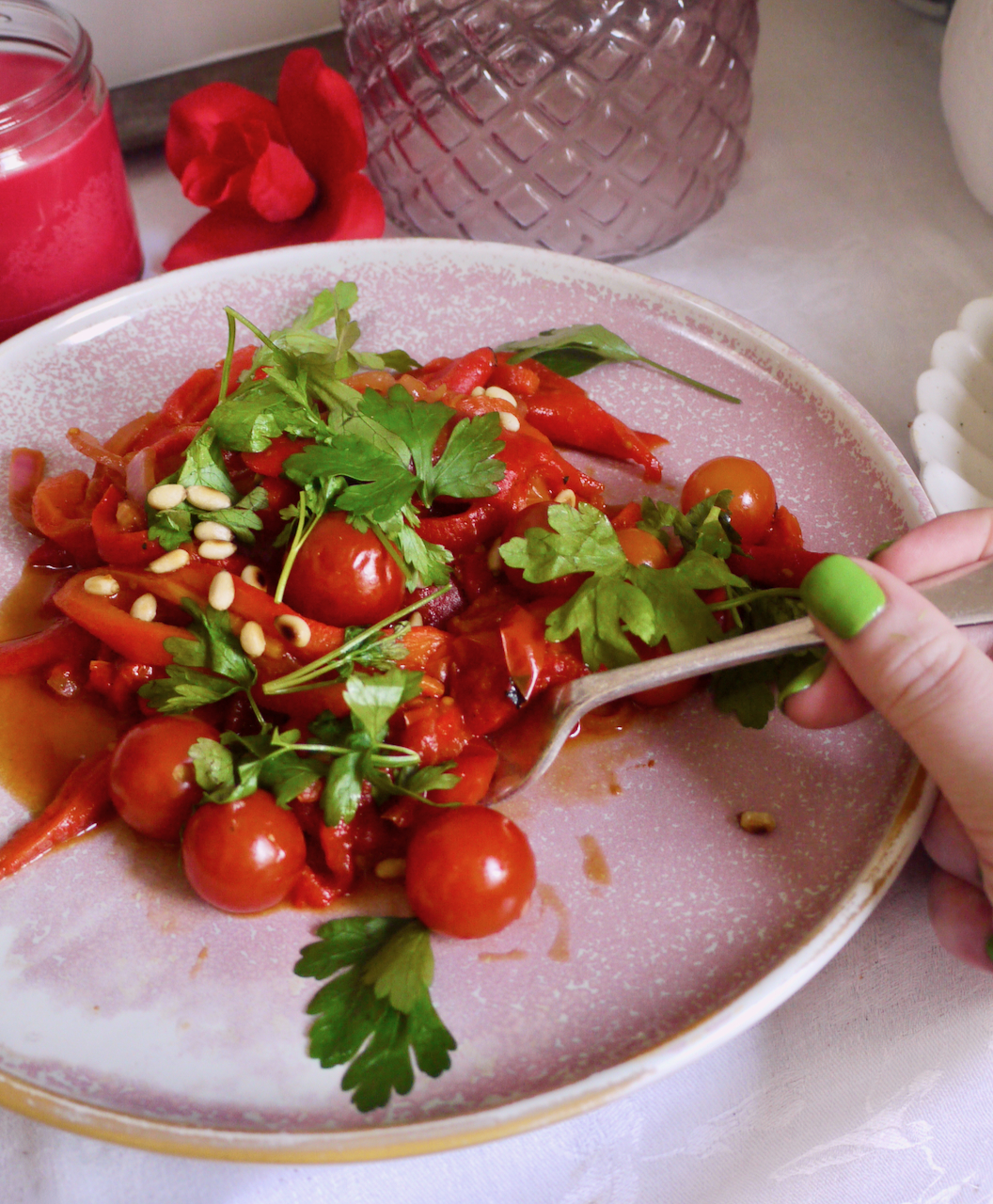
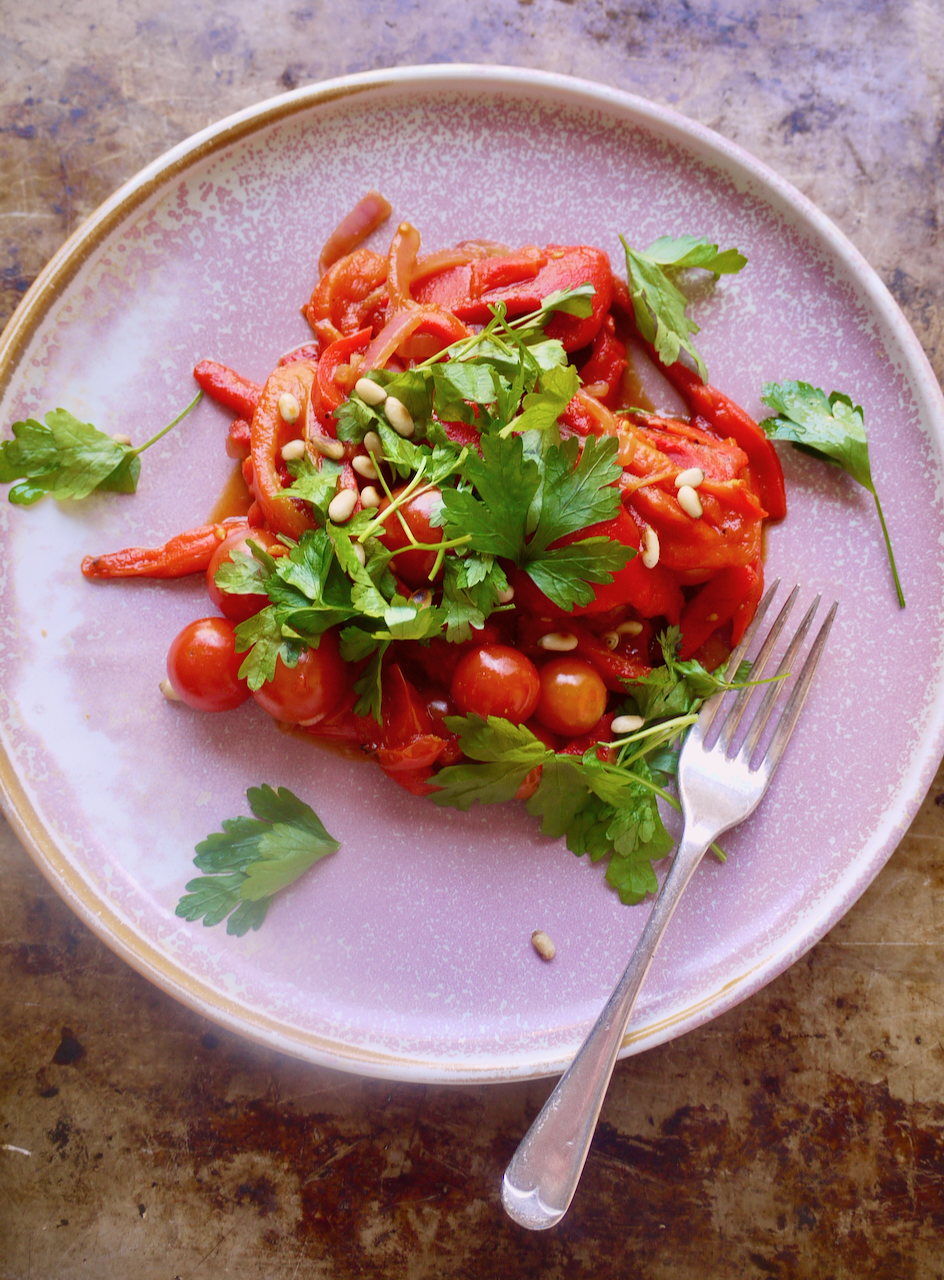
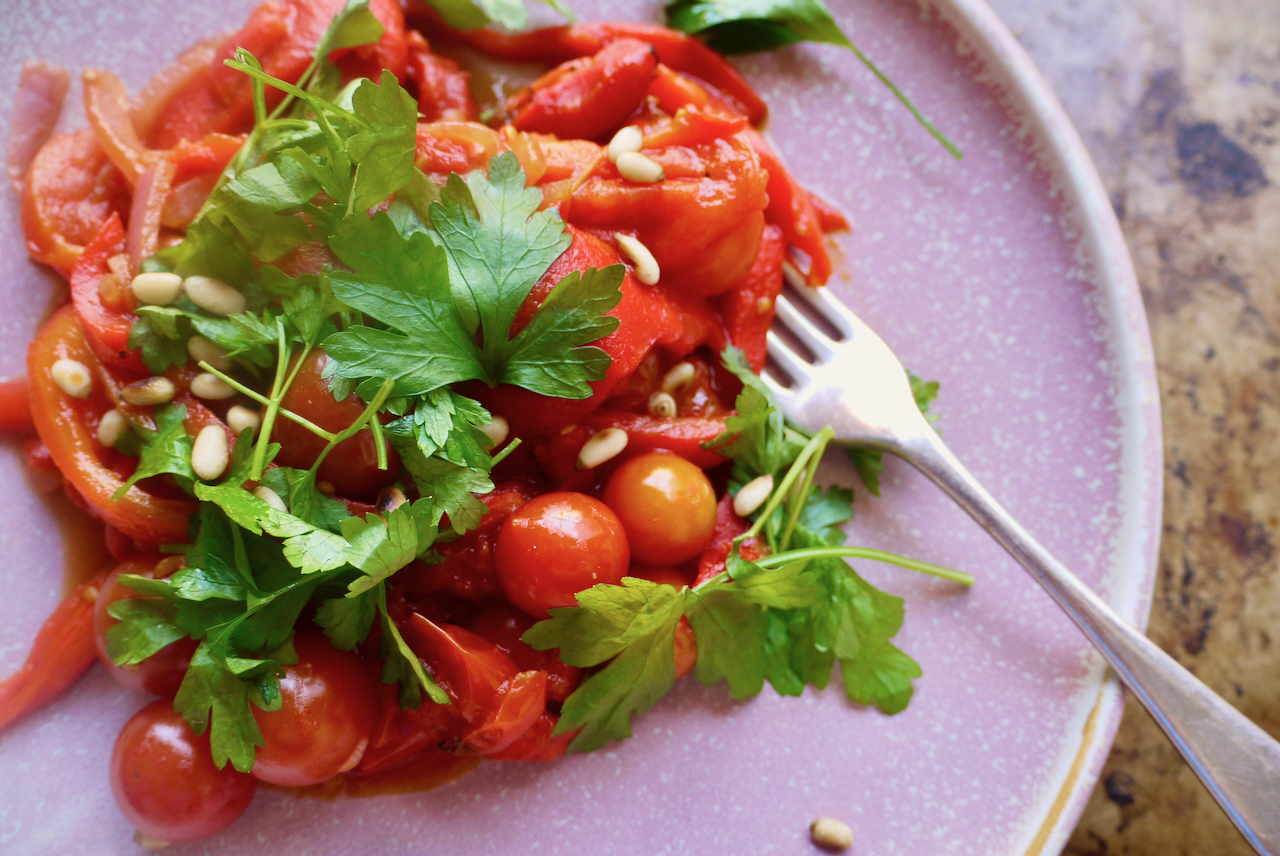
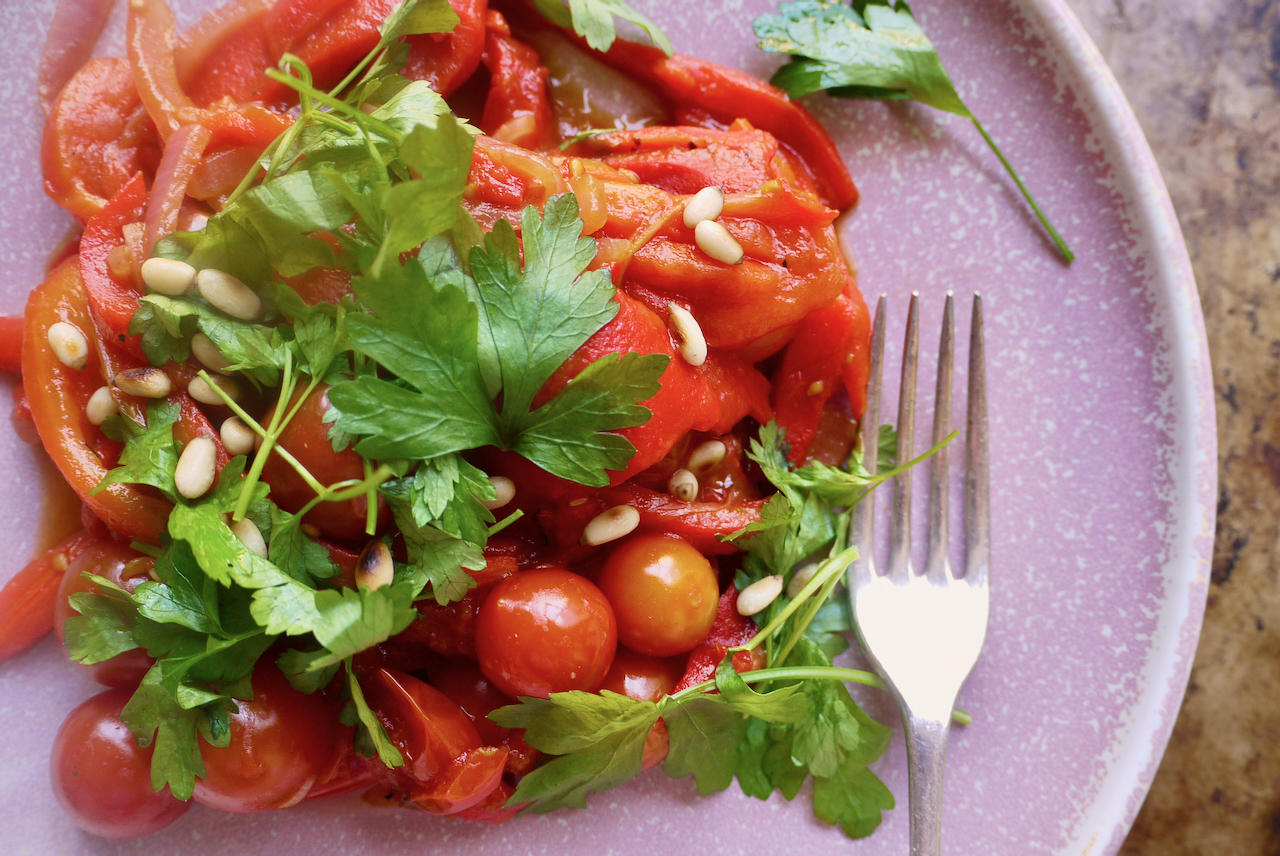
But! It’s also perfect as is, enlivened only by the celery-fresh flat-leaf parsley and an elegant scattering of pine nuts. Doubled, this would make a splendid Christmas side dish, glowing with Yuletide colours, made even more appealing by its dream-guest well behaved qualities — it tastes delicious cold, at room temperature, and reheated, and seems to get better the longer it sits around. That rare treat — a dish that asks so little yet gives so much.
If you’re after more year-round pantry-based tomato recipes that don’t rely on mercurial seasonal produce, I recommend this Creamy Gochujang Pasta; Tomato Couscous with Cinnamon, Peanuts, and Coriander; Tomato and Bread Soup with Fried Carrot Pesto; Zibdiyit Gambari; and Oven-baked Pearl Couscous with Pumpkin, Sundried Tomato, and Feta.

Pipérade for all seasons
A slight tweak here and there to this Basque recipe means you can enjoy it in the bleakest midwinter, or indeed, the bleakest summer. This dish of collapsed, sweet and smoky peppers and tomatoes is fast and versatile, I truly love it. Adaptation by myself, but this is a traditional recipe that I obviously did not invent. Also – although we call peppers ‘capsicums’ in New Zealand, every company who roasts and jars them uses the ‘peppers’ nomenclature so that’s what I’m going with here.
- A red onion
- 3 fat garlic cloves
- 1 tablespoon olive oil, plus more for serving
- 1 x 680g jar roasted red peppers (this is the size jar that’s at my supermarket, this won’t burst into flames if your jar is slightly larger or smaller)
- 1 x 400g can cherry tomatoes
- A pinch of espelette pepper, or 1 teaspoon smoked paprika (see notes)
- 1 teaspoon sugar
- 3 tablespoons pine nuts
- A small handful flat-leaf parsley – about 10g
- Salt and pepper, to taste
1: Peel the red onion, slice in half lengthways, and then slice each side finely into half-moons. Peel and roughly chop the garlic cloves. Warm the olive oil in a wide saucepan and gently fry the onion and garlic without browning, sprinkling with a little salt to soften them.
2: Drain the jar of roasted peppers and slice each one into lengths of about 1cm wide, though it really doesn’t matter. You may want to remove the pan of onion from the heat while you do this, to prevent them browning. Add the sliced peppers to the pan, along with the can — undrained — of cherry tomatoes.
3: Now you can raise the heat, add the pinch of espelette pepper or teaspoon of smoked paprika along with the teaspoon of sugar, and let everything come to a good brisk simmer, stirring occasionally, for about ten minutes. Add a splash of water if it appears to be getting too dry, but otherwise just prod now and then with a wooden spoon. Some of the tomatoes will burst, some will stay whole, this is fine.
4: While this is happening, toast the three tablespoons of pine nuts in a dry pan over a medium heat until lightly browned and fragrant. Any time I’m toasting nuts or seeds this way, I don’t consider the pan in need of washing after, but if you want you can toast the nuts first in the same pan you’ll later cook the pipérade in, just to be extra efficient.
5: Once the pipérade looks good and jammily amalgamated, remove it from the heat, taste for salt and pepper, and serve with the roughly torn handful of flat-leaf parsley, the toasted pine nuts, and perhaps an extra swirl of olive oil if you wish.
This could serve up to four people as a side dish on a crowded plate, more if part of a potluck table where only a small spoonful is expected, otherwise it will serve two people as a light meal with bread alongside for swiping.
Note:
- I first made this in the middle of lockdown when I had to make use with what I had, which in this case, was smoked paprika instead of the traditional espelette pepper. If you can get hold of the latter, then use it, but I’ve made this numerous times with smoked paprika and love it, despite it not being an exact 1:1 dupe.
- To make this with fresh produce, use 4 red, orange, or yellow capsicums, about 400g cherry tomatoes, and be prepared to simmer for a lot longer and add a little water.
Alas, this really does taste better with cherry tomatoes of the fresh or canned variety, but if you can’t find them I’d go for canned, diced tomatoes in juice.
music lately:
Pivot and Scrape by Sophie Thatcher, this is diaphanous, brooding, momentous yet contained, orotund (not in the pejorative sense), makes you feel like you’re flying in a dream but also floating in a pool of warm water, it’s just…exactly what my ears want to hear.
Trees by The Cry, it has a shimmering, just-rained melancholy optimism, like seeing a rainbow but not being able to get any closer to it.
Bless the Lord from Godspell by Lynne Thigpen; it’s not often that the film soundtrack exceeds the original cast recording of a Broadway adaptation (or, in this rare occasion, off-Broadway), but having listened to an inordinate number of Godspell cast recordings this one is by far my favourite — it neither over- nor undercooks, Lynne Thigpen’s voice and delivery is so exhilarating, and the way she sings “oh yeah” at one minute and seven seconds in practically sends me into orbit, I can’t believe no one has sampled it for anything yet.
Kissability, by Sonic Youth. Those guitars at the start make me want to act up.
PS: As I’ve said previously, ReliefAid’s Gaza Appeal is important to me. Their team, through perishingly difficult circumstances, are on the ground trying to help. They updated this week to report that they’ve helped provide food, water, and support to over 400,000 people — if you’re looking for relief effort to support in Palestine, I suggest them as a starting point.

 Hungry and Frozen
2 thoughts on “Pipérade for all seasons”