

To paraphrase myself: If your perception of an ingredient is polluted by the disdainful memory of it being served prosaically and—most likely—boiled into limp oblivion, then do yourself a favour and look to those who are doing it better. Sami Tamimi’s new book Boustany: A Celebration of Vegetables From My Palestine demonstrates this point, having made me view silverbeet, or chard as it’s known in other hemispheres, with new and acquiescent appreciation through this recipe for Silek ma’ Basal. To that end: These are beyond catastrophic times for Palestine, as well you know. I don’t have enough of a platform to render talking or not talking about food particularly impactful either way. The food of Palestine is beautiful and so is this book; uplifting it is a privilege and I can only hope that any person who denies Palestinians their own food, tastes nothing but the ash and dirt of their own souls in their mouths forevermore. Onwards.

Although there are boundless recipes that present with more immediacy in this book, Sami’s note that “chard, or sileq, is one of the most popular greens in Palestine” caught my eye and had me thinking that perhaps my writing off an entire branch of the Betoideae family could in fact be, as they say, a skill issue. Naturally, it was. Not that I hate silverbeet, it’s just that its predominent metallic wet floppiness doesn’t have it leaping to mind as a viable dinner option as much as, say, a block of white chocolate.
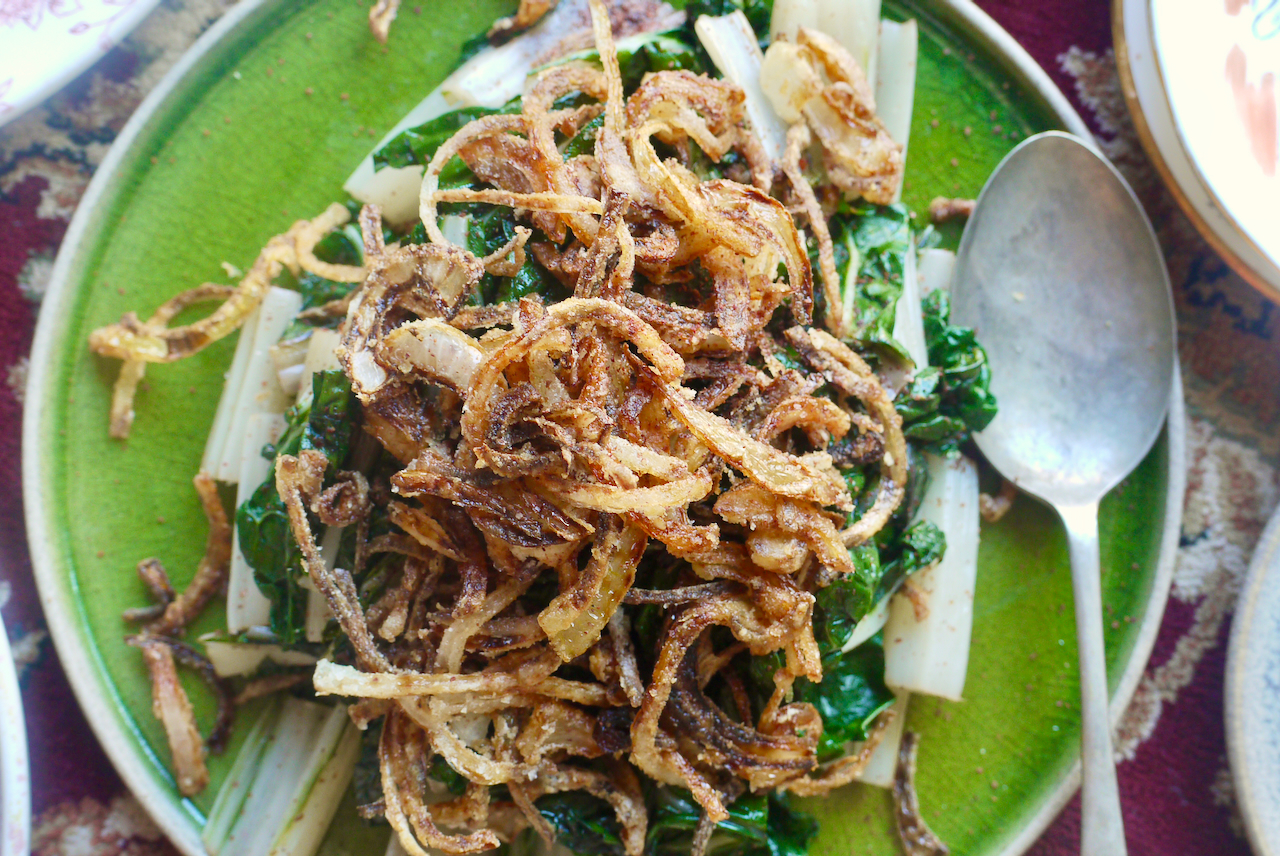
Here—and there are a few steps and a few pans, but I for one enjoy taking part in a process—the silverbeet is lightly dunked in salted water, drained, and pan-warmed through with olive oil and lemony-sharp pinpricks of sumac, red as pōhutukawa needles against the green leaves. The raucous coppery edge of the silverbeet is somehow softened and made palatable through the cooking method and the cushioning olive oil and salt; to say nothing of the tangle of crisped onions providing savoury lusciousness, whimsy, and texture. Everything is a feast in this economy, but taking two of the humblest ingredients and rendering them this genuinely banquet-like is the act of a truly superior cuisine.

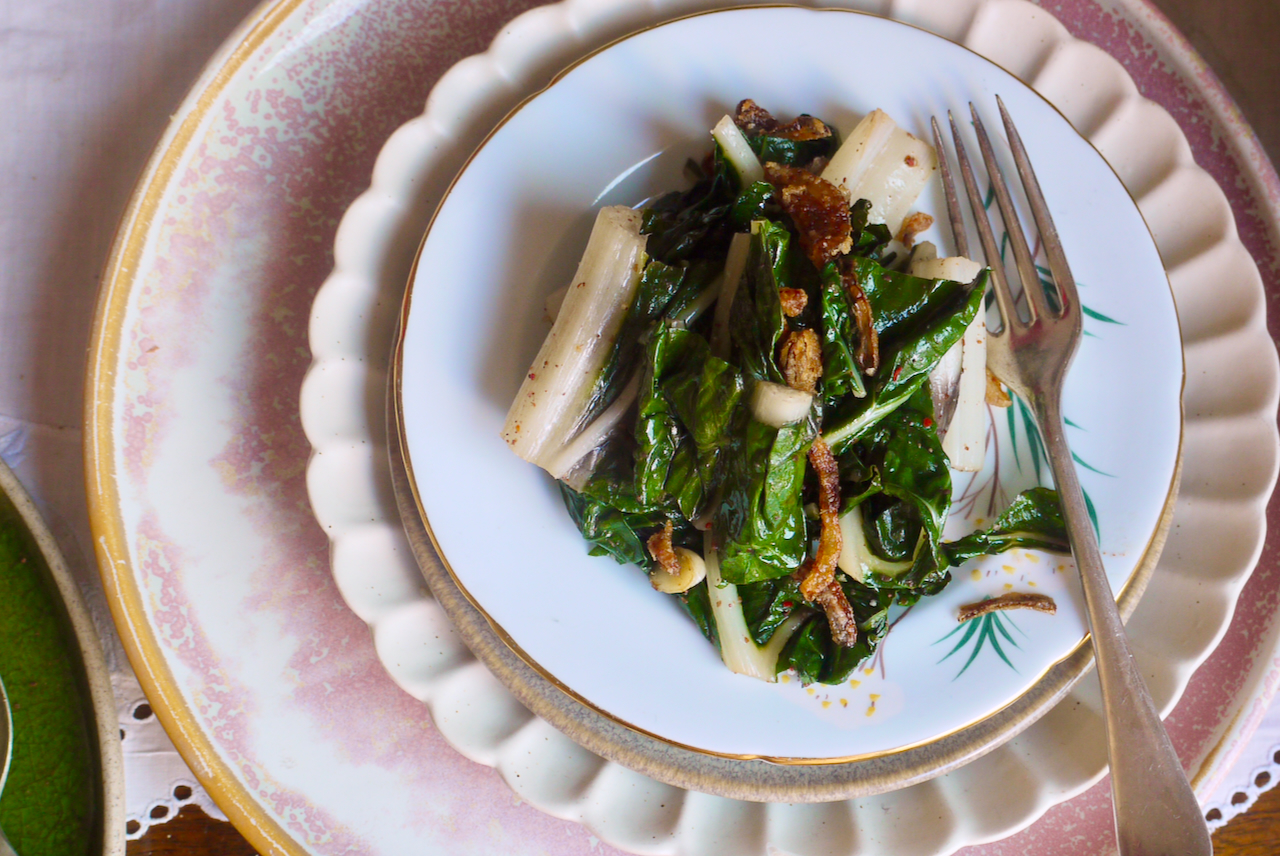
I’d proudly serve this to guests as a side dish or as part of a table laden with small plates; I can also highly recommend it as dinner in its entirety for two of you or—just yourself—accompanied by an egg, or perhaps a dense crumbling of feta. Something I love about Boustany is that it is also a celebration and preservation of language, with every recipe given a title in Arabic. I can’t wait to cook more from this book, and no doubt you’ll be hearing about it.
For more dishes celebrating the vegetable-forward culinary excellence of Palestine, I recommend this M’tabbal Qarae, also by Sami Tamimi, along with these recipes for Banadora Wa Sumac, Msabaha, and Shorbat Jarjir.
And if I may, a reminder that you can sign up here to hear irregular and unobtrusive updates and details about my forthcoming 2025 debut novel, Hoods Landing. Find out more, which you probably already know, at my official author website. You can also, thrillingly, pre-order it worldwide and locally here.

Silek ma’ Basal [Braised silverbeet with crispy onions and sumac]
The recipe that got me to eat half a kilo of silverbeet in one sitting, I’m not sure I can give a stronger recommendation than that. This comes from Sami Tamimi’s new book Boustany, I haven’t altered the method or ingredients but have rewritten it in my own words below—though I slightly increased the quantity of onion to account for how much of it I would eat eat between cooking and plating. Before purchasing any ingredients, I first recommend referencing Boycott Zine Aotearoa’s useful guide so you know which brands to avoid.
- 450g silverbeet aka Swiss chard
- 90ml sunflower oil or other neutral oil
- 1 large onion
- 1 tablespoon cornflour
- 3 tablespoons olive oil
- 1 garlic clove
- 1/4 teaspoon Aleppo chilli flakes, or regular chilli flakes—I used gochugaru
- 2 teaspoons sumac
- Salt, for seasoning
- Lemon wedges, to serve
1: Trim the bulbous end off the 450g silverbeet, assuming it came still connected, and rinse the stalks and leaves if necessary. Chop the white stalks into 3cm lengths, and then chop the leaves roughly into 2cm pieces. Bring a large pan of salted water to the boil—the kind of sized pan you’d confidently cook pasta in.
2: Once the water is boiling, drop in the chopped white stalks, lower to a simmer and cook for three minutes; then throw in the silverbeet leaves and cook for another two minutes. Drain into a sieve or colander, and let the pan sit, off the heat, with the sieve of draining silverbeet resting on top of it.
3: Peel and finely slice the large onion into half-moons, use your fingers to separate and splay the slices from each other and toss with the tablespoon of cornflour. While this is happening, heat up the 90ml plain oil in a heavy-based saucepan—Sami recommends using a small, high-sided pan but all I had was a large saucepan and increasing the surface area didn’t do me or the onions any harm.
4: In small batches, carefully fry the cornflour-coated onion slices until golden brown—the first batch will take a few minutes to turn golden but the rest should move fairly quickly as the oil heats up more vigorously—and as they cook, remove to a side plate with tongs or a slotted spoon, and sprinkle with salt.
5: Once this is done and the oil is off the heat, either get out another saucepan, or carefully dispose of the oil and wipe this with a couple of paper towels, readying it to use again. Either way, heat up the three tablespoons of olive oil and while this is happening, finely slice the garlic clove. Stir the garlic clove in the olive oil for a minute or two until it’s lightly golden.
6: Squeeze as much water as possible from the silverbeet—which should be cool enough to handle now—and add it to the pan with the garlic, stirring for two minutes. At this point, remove the pan from the heat and stir in the 1/4 teaspoon chilli flakes, one teaspoon of the sumac, and a pinch of salt.
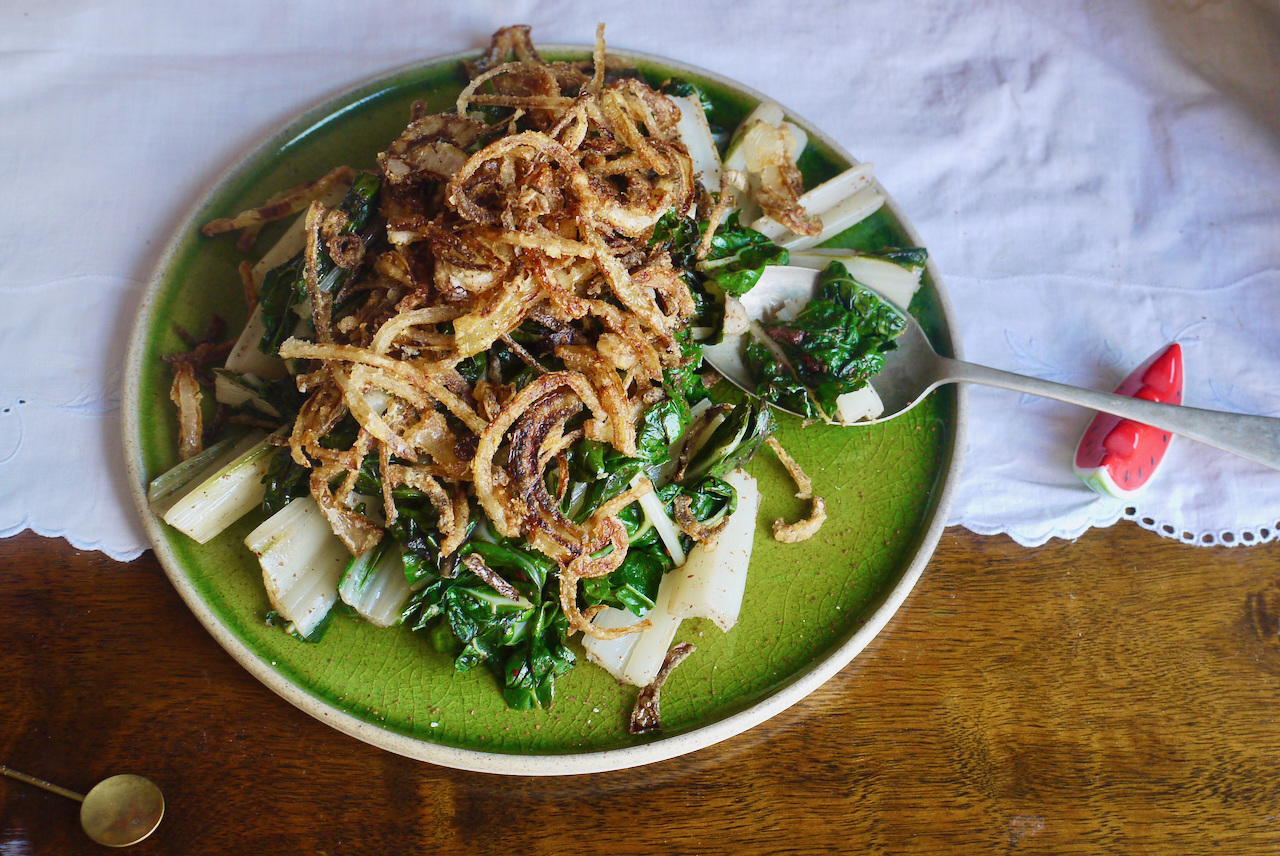
7: Transfer the cooked silverbeet to a large serving plate, spreading it into a flattish layer, and top with the crispy onions. Sprinkle with the remaining teaspoon of sumac and serve with the lemon wedges.
Serves 4 as a side, or as part of a table laden with many dishes. I however have eaten this by myself in its entirety, topped with an egg—stunning.
Notes:
This is best eaten immediately, otherwise the onions start to lose their crisp-ity; which is not to say that I haven’t eaten and enjoyed leftovers with the onions as wilted as the greens, but it shouldn’t be your first impression of the dish.
music lately:
Celebrated Summer by Hüsker Dü; I say this with all the irritating stolen valour of someone born in 1986 but nonetheless the 80s were an excellent decade for beautifully simple, cheerful melodies paired with difficult and combative production values!
Mirtazipine, brand new from the vocally agile Hayley Williams. Those layered, warmly nervous guitars…I know she’s been listening to My Bloody Valentine…I am not someone who seeks hyper-specific representation as a means to an end but it was undeniably nice to feel seen by a song about the titular little pink pills. I also love the biblically ominous True Believer from her new collection.
As a real Jesus Christ Superstar-head since I saw the life-changing 1994 New Zealand cast with the late Margaret Urlich as Mary Magdalene, I have been captivated by the clips of the Hollywood Bowl concert staging with Cynthia Erivo as Jesus and Adam Lambert as Judas, the cast of which is honestly stunning enough to make one an evangelical convert to Andrew Lloyd Webber’s songwriting skills. The only thing keeping me tethered to earth is the fact that they rudely cut short the swirling, hypnotic ending of Everything’s Alright, which, with Pippa Soo as Mary, is still giddily momentous.
PS: Feeling hopeless is a luxury that serves no one but those perpetrating the hopelessness. You can donate to ReliefAid’s Gaza Appeal, who are connected with teams on the ground in Gaza; you can donate to Convoys of Good, another registered NZ charity distributing aid. If you’re in Pōneke, check out this kid-led and kid-friendly fundraising event on 24 August. As I’ve already mentioned, you can also demonstrate your control and power through the absence of your dollars. Boycott Zine Aotearoa has helpfully put together two comprehensive free zines so you can quickly see who to studiously avoid when buying food, drinks, household items and beauty products.

 Hungry and Frozen
2 thoughts on “Silek ma’ Basal [Braised silverbeet with crispy onions and sumac]”