
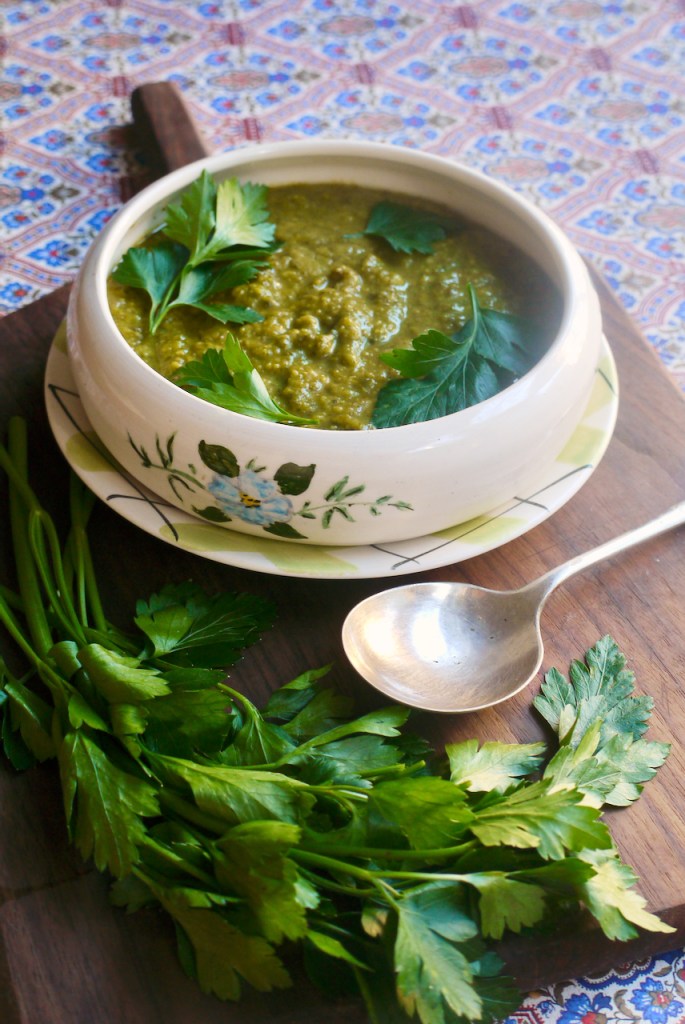
Big green soup

A bowl of soup on a wooden board with a bushel of flat leaf parsley and a spoon on it

Whatever it is going on in my brain, be it nameable or undesignated, it only occasionally manifests in the form of what is commonly known as ‘food hyperfixation’. I’ve always been emotionally fixated on the idea of food, specifically, cooking it—experiencing a certain scarcity-minded franticness when I’m unable to cook, which I suspect is, at the least, a bit weird. Now and then, though, a certain food will cohabitate with my habits, like having a writer in residence staying with you: this past week it was lentils. I yearned for their collapsing bodies, tipping them like a rainstick into a bowl ready to soak with cool water, endlessly testing little simmering spoonfuls—no, still not cooked yet.

This recipe for Big Green Soup actually uses split peas, but! Lentil Week is a state of mind type of nomenclature. Speaking of nomenclature, the recipe title misleads not at all: it’s Big (makes over a litre); it’s Green (if you have 400g of silverbeet drooping malevolently in the fridge, this is for you); and it sure is Soup. It is also, of course, delicious. That’s why we’re here.

Continue reading

Silek ma’ Basal [Braised silverbeet with crispy onions and sumac]

Silverbeet and fried onions on a green plate with a serving spoon, surrounded by different coloured plates

To paraphrase myself: If your perception of an ingredient is polluted by the disdainful memory of it being served prosaically and—most likely—boiled into limp oblivion, then do yourself a favour and look to those who are doing it better. Sami Tamimi’s new book Boustany: A Celebration of Vegetables From My Palestine demonstrates this point, having made me view silverbeet, or chard as it’s known in other hemispheres, with new and acquiescent appreciation through this recipe for Silek ma’ Basal. To that end: These are beyond catastrophic times for Palestine, as well you know. I don’t have enough of a platform to render talking or not talking about food particularly impactful either way. The food of Palestine is beautiful and so is this book; uplifting it is a privilege and I can only hope that any person who denies Palestinians their own food, tastes nothing but the ash and dirt of their own souls in their mouths forevermore. Onwards.

Continue reading