

One of the more lamentable ways I begin sentences these days is “I saw this in a screenshot of a tweet on Instagram”. Now, to be fair, I could try receiving information in more highbrow, or at least more trustworthy formats and sources but those formats and sources are mostly decaying and I haven’t quite shaken the time-corrupting doomscroll muscle memory just yet, so here we nevertheless find ourselves. To that end; I saw a screenshot on Instagram of a tweet by cowboypraxis that said “i tried to make two plans in one day. as if i were god. as if i were literal god.” and I understood completely; My weekend comprised two such that-way-lies-folly plan-filled days, and yet! This Sha’aktoura from Sami Tamimi’s new cookbook Boustany is so breathtakingly calm and accommodating to cook that it can both be a plan and fit around your plans and make you feel really rather godlike in the process. Or, at the least, like someone who doesn’t begin sentences by referencing screenshots on Instagram.
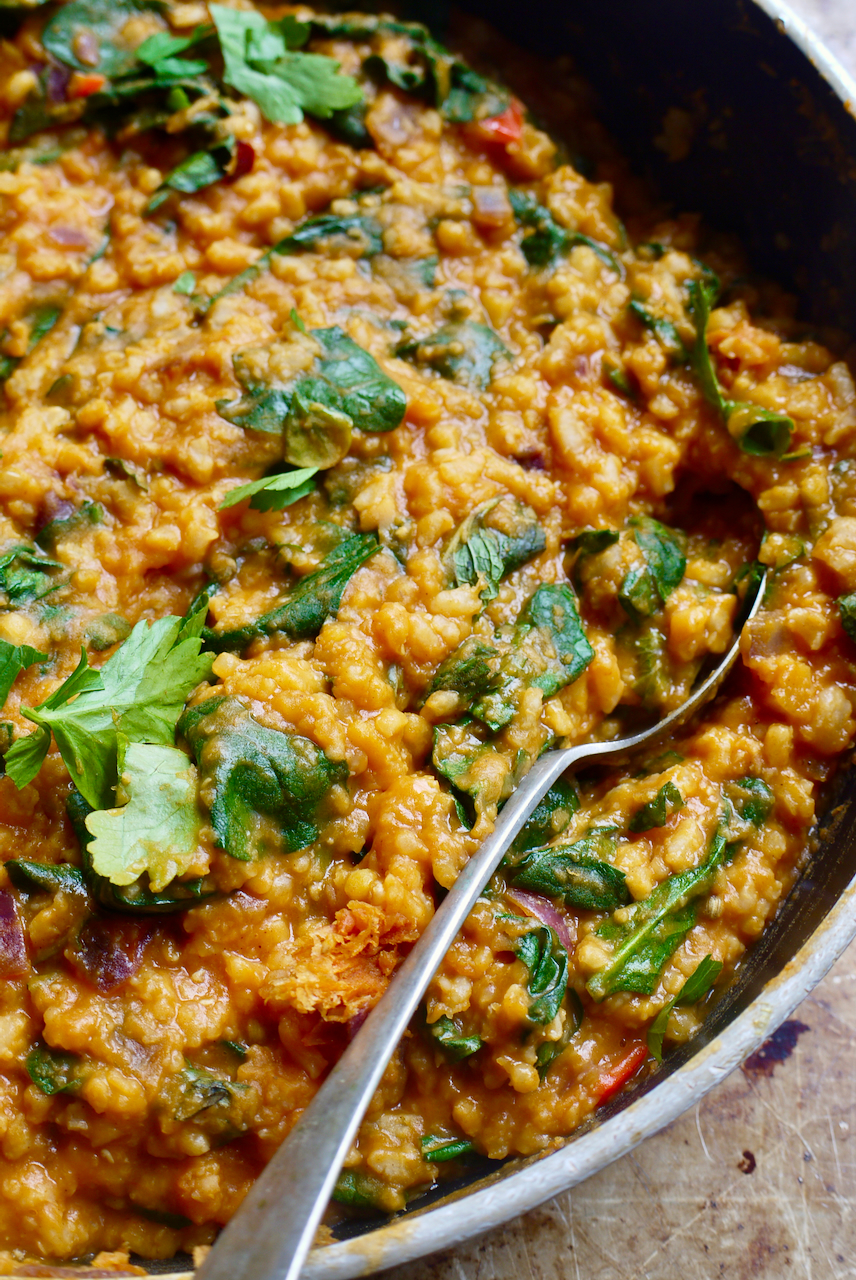
This Palestinian recipe from Hebron for rice and lentil pilaf occupies a stunningly ombré grey area between many absolutes:
- It tastes of slow-simmered long hours but can be ready in about 30 minutes
- The texture is pure somnolent-soft comfort yet the flavours are invigorating and freshly vivacious
- The ingredients list is undeniably rather lengthy but it feels like no effort at all
- It’s not quite soup, not quite risotto; yet evokes both
- Rice and lentils are self-effacingly modest and yet this feels banquet-ready and lush

The starchy, earthy rice and lentils collapse into each other; providing the yieldingly soft base for a vivid rush of chilli, garlic, ginger—the latter honestly providing more heat than the chilli—along with lemony pops of coriander seed and literal lemon, a brief acidic-sweet smear of tomato paste, as much spinach as you can cram into the pan, and headily cooling mint. I omitted the coriander only because my girlfriend has the coriander-tastes-like-soap thing; I can see how its rich verdant freshness would shine here but it was by no means lacking without.

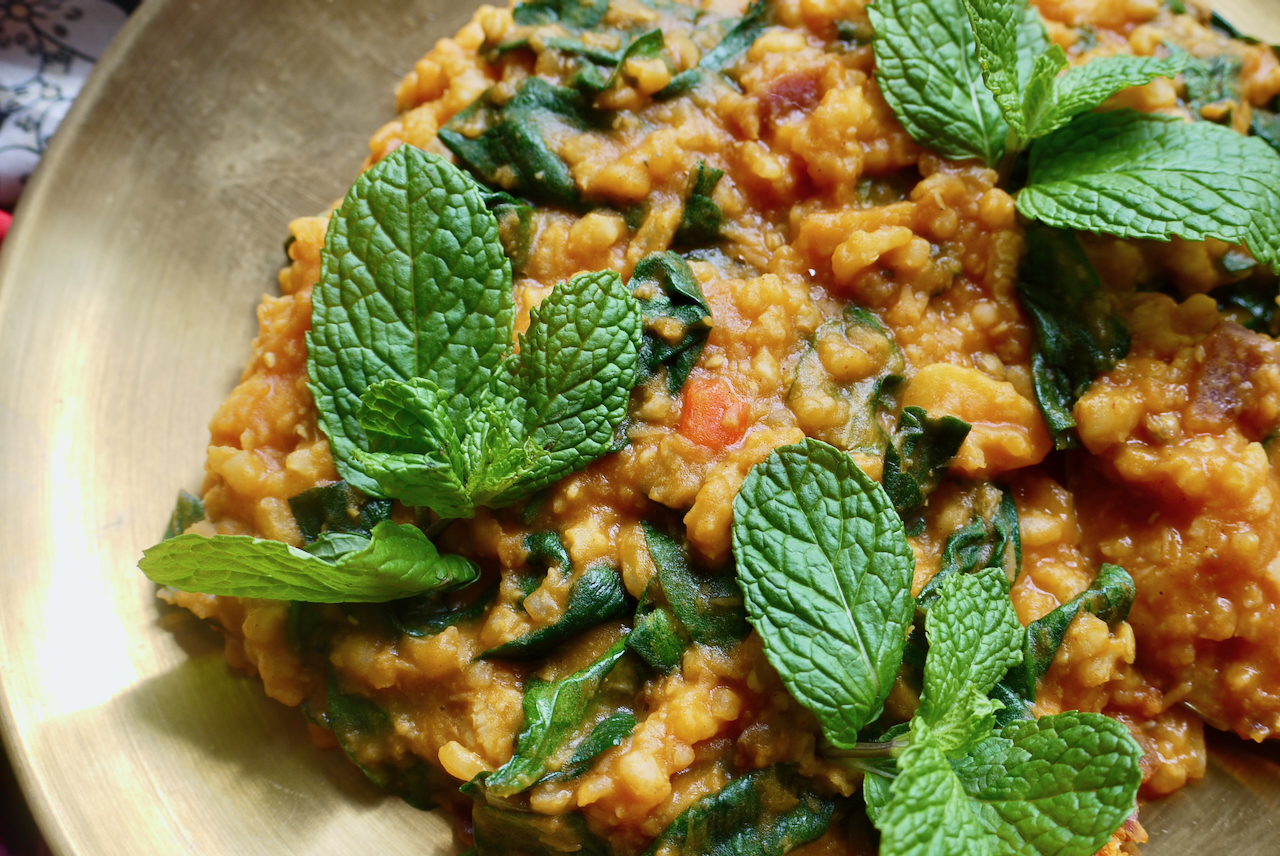
Because this makes an absolute vatful and is not overly expensive ingredients-wise—not to mention the relative short cooking time and the fact that it lasts well—this recipe is ideal to have in your back pocket for a weary, rain-pelted easy dinner that begets more dinners, and more still if you lean into its soupier potential which will further lengthen the numbers of people it can feed. That said, it needn’t be relegated to a humble, hastily-consumed, and half-asleep dinner—as I noted above, the dynamic chorus of flavours and vast quantities, and the fact that it’s vegan and gluten-free, make this amenable to serve to a table of guests. I would blanket it with more freshly chopped herbs along with some chopped pistachios or toasted pine nuts for further celebratory glamour; with piles of warmed flatbreads alongside.

As I mentioned in the previous recipe that I shared from this book; no uplifting of Palestinian food can go by without also acknowledging the catastrophic and diabolically evil circumstances the people of this country are and have been under, separated not only from their food traditions but from food full stop. It’s a privilege to be able to celebrate their food, not one I take lightly. This book, Boustany, certainly makes it easy to do so with its page after page of glorious recipes. I am glad to have it and hope for better times and change ahead. Marching earlier this month with over 40,000 people—and for every person who was there, more besides were in spirit—gave me hope that at least the majority of us are united on the right side.

If you are after more delicious recipes from Palestine, I also recommend this Silek Ma’Basal from Boustany; this Shorbat Jarjir and this recipe for Msabaha.
And if I may, a reminder that my debut novel Hoods Landing will be published by Āporo Press on 31 October; the launch party will be that same day in Wellington and on 13 November in Auckland. If you’re not going to buy it at the launch, you can also, thrillingly, pre-order Hoods Landing worldwide and locally for delivery or pickup—tell your friends! Tell your enemies! Tell the indifferent, who could be swayed in either direction! Find out more, which you probably already know, at my official author website.
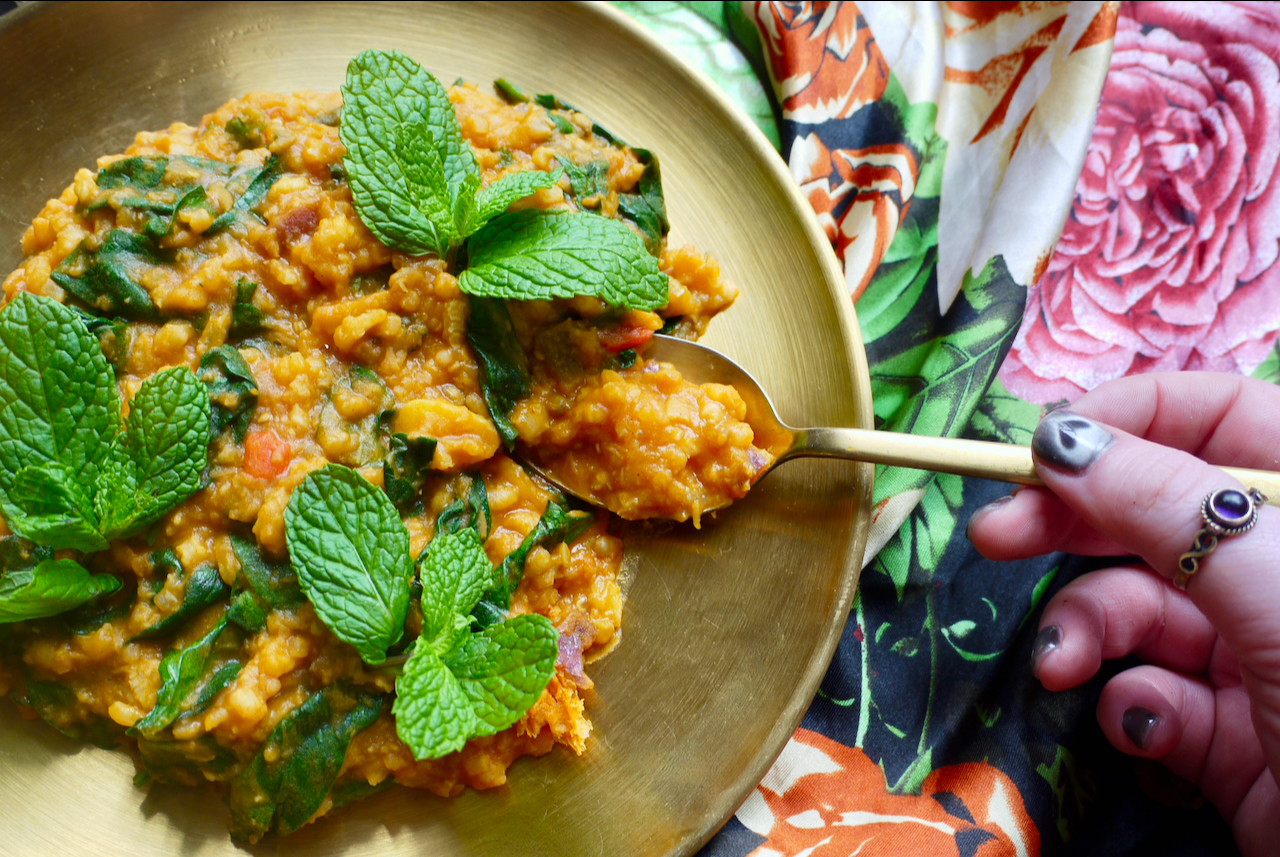
Sha’aktoura (rice and lentil pilaf)
A comforting yet enlivening and incredibly delicious recipe from Sami Tamimi’s book Boustany, it’s relinquishingly soft enough to bring cosiness on a rainy day yet effervescently flavoursome and flourish-y enough to serve to guests. Before going shopping for these or any ingredients, I recommend checking out the Boycott Aotearoa zines so you know which brands to avoid. Recipe slightly adapted, see notes.
- 1 litre water
- 175g (1 cup) Arborio or similar risotto-friendly rice
- 160g (1 cup) red lentils
- 1/2 teaspoon salt, plus more to taste
- 1 onion
- 5 garlic cloves
- 2 inches fresh ginger
- 1 red chilli (or green, as per the original recipe)
- 3 tablespoons olive oil
- 1 and 1/2 teaspoons ground cumin
- 1 and 1/2 teaspoons coriander seeds
- 1 teaspoon cinnamon
- 1/2 teaspoon turmeric
- Black pepper
- 2 tablespoons tomato paste
- 300ml water, extra
- 120g baby spinach leaves (see notes)
- 15g fresh mint
- 15g fresh Italian parsley (or the originally specified coriander)
- 3 tablespoons fresh lemon juice
1: Bring the litre of water to the boil in a large pan (or boil it in the jug and pour it in). Meanwhile, rinse the 175g rice and 160g lentils together in a sieve. Once the water is boiling, add the half teaspoon of salt and pour in the rice and lentils. Let it come to the boil then lower the heat and simmer, stirring occasionally until the rice is very soft, and the lentils have completely collapsed. This shouldn’t take more than 20 minutes. Set aside. You can do this step ahead of time, letting it cool and then refrigerating it, which will make it even easier (I just left the pan on the bench for a couple hours, which I probably shouldn’t recommend to you for safety reasons…but it was fine.)
2: While the pan is simmering, finely dice the onion and push to one side of the chopping board, then finely dice the five garlic cloves, the two inches of fresh ginger, and the chilli, flicking away the seeds into the sink if you want the heat to be milder. Warm the three tablespoons of olive oil in a wide pan and add the diced onion, letting it fry until softened and lightly browned.
3: Add the chopped garlic, ginger and chilli to the pan, continuing to stir for another two minutes, then add the one and a half teaspoons each of ground cumin and coriander seeds; the teaspoon of cinnamon and the half teaspoon turmeric, along with a good pinch of pepper. Stir this into the onion and aromatics, then stir in the two tablespoons of tomato paste.
4: Now, tip your pan of softened rice and lentils into this mixture, along with up to 300ml water, depending on the consistency you’re after—I only used about half that, as I wanted this to be a little thicker—and once that has come to the boil, stir in the 120g baby spinach, letting it wilt completely in the heat. Roughly chop the 15g each mint and Italian parsely and stir that in too, along with the three tablespoons of lemon juice. Taste to see if it needs more salt.
Makes an enormous panful, this could easily serve six people with generous bread of some kind alongside for swiping; with four people you’ll probably be blessed with leftovers, fortunately it tastes amazing the next day.
Notes:
- Regarding spinach—the original recipe calls for 500g defrosted frozen spinach; I prefer fresh baby spinach and while 120g is immensely plentiful, this could absorb more. Use as much as you want between those two quantities.
- I’m sure this would be fantastic with coriander; there is still plenty going on without it, but I added some flat-leaf parsley for extra fresh greenery. I’ve specified 15g of each fresh herb since that’s the size packet they tend to come in here, but use several handfuls if you’re grabbing it off a plant at home.
- The original recipe suggested to grind the coriander seeds but I left them whole for texture (and ease, admittedly).
music lately:
Sycamore Trees by Jimmy Scott. To be perhaps the most haunting song in two soul-scrapingly haunting seasons of music in Twin Peaks is really something, but Scott’s voice takes us there.
Charades by Tim Reaper with Mantra and Decibella, if there’s a name for that sky-blue, tingly effect that opens this optimistic and bewitching stunner then I’d like to know because it felt like an aspirin for the brain (which is, I guess, an aspirin) and I want a playlist of songs that use it; as per usual I heard this song thanks to the erudite recommendations of one Martyn Pepperell, if you are ever in need of new-to-you music his newsletter has you sorted.
View Master by Eric’s Trip, hard of riff and soft of vocals and completely enrapturing.
PS: Feeling hopeless is a luxury that serves no one but those perpetrating the hopelessness. You can donate to ReliefAid’s Gaza Appeal, who are connected with teams on the ground in Gaza; you can donate to Convoys of Good, another registered NZ charity distributing aid. You can also donate to mutual aid accounts or support the people fundraising via Emily Writes’ Tents 4 Gaza appeal to supply families in Palestine with shelter. As I’ve already mentioned, you can also demonstrate your control and power through the absence of your dollars. Boycott Zine Aotearoa has helpfully put together two comprehensive free zines so you can quickly see who to studiously avoid when buying food, drinks, household items and beauty products.


 Hungry and Frozen
One thought on “Sha’aktoura (rice and lentil pilaf)”