vegan rhubarb panna cotta

IMG_8890

The alluring culinary dichotomy of sour and sweet is present in numerous fruits but enjoys arguably its prettiest expression in the vivid magenta blush of roasted rhubarb. And there’s nothing like adding a creamy, fat element to this – a tri-chotomy? I’m sorry! I know words have meaning! – to truly enhance its colour and flavour, like wearing an enormous fluffy coat with a tiny slip dress: there’s contrast and balance.

Now, you’d think my lack of object permanence would cause a container of roasted rhubarb to languish in the fridge, entirely forgotten before I’d even closed the door, but fortunately for all involved a secondary function of my brain kicked into gear, where I commence a random and often barely relevant task as if by automatism and wake up halfway through; in this case the morning after roasting the rhubarb I found myself, entirely without thinking, making a pink variation of the passionfruit panna cotta I rapturised about back in March.

IMG_8888

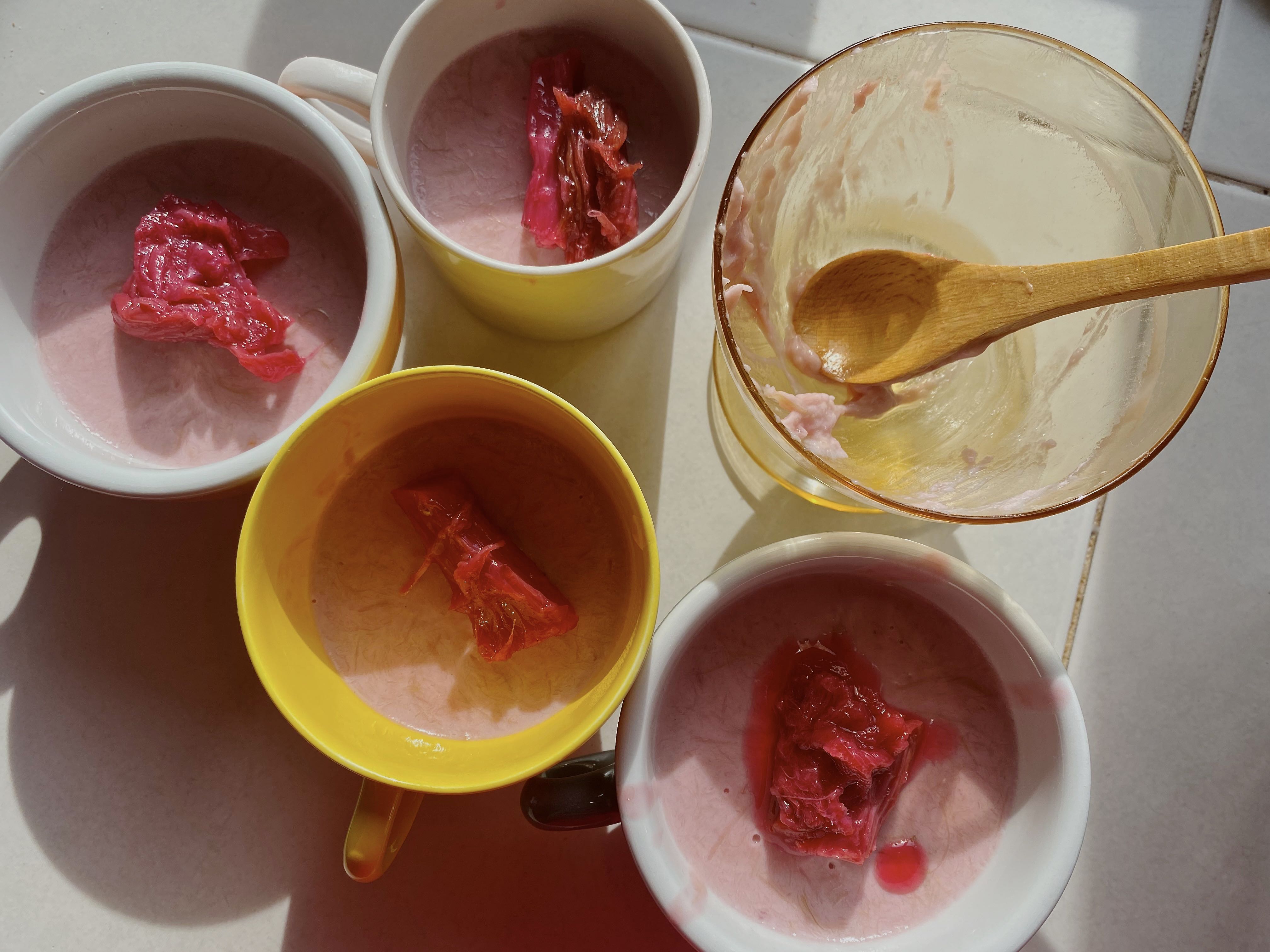
This is a delightful way to come up with new recipes – by taking an existing recipe I love and sliding in a new ingredient, mad-libs style. There is obviously no points system at play here but if there were I would give bonus credit to any such recipe where a half-assed, barely-thought-out replacement ingredient proved so deliciously perfect that at the very last minute I decided to blog about it. But subconsciously I must have known I was onto a winner because I divided most of the mixture between four glasses with a little extra in a fifth glass as a “tester” – surely the actions of a person who suspected they’d want to make sure the recipe worked so they could photograph the remaining desserts in an attractive tableau before the intermittent winter sunlight faded altogether. Also, I took videos of the cooking process for a TikTok which really makes it sound like this was all planned in advance but again: I can’t stress enough how many things I do without thinking! It’s possible! It’s horribly annoying! It’s rarely anything useful! Not once have I zoned in on myself industriously tidying my room or paying bills.

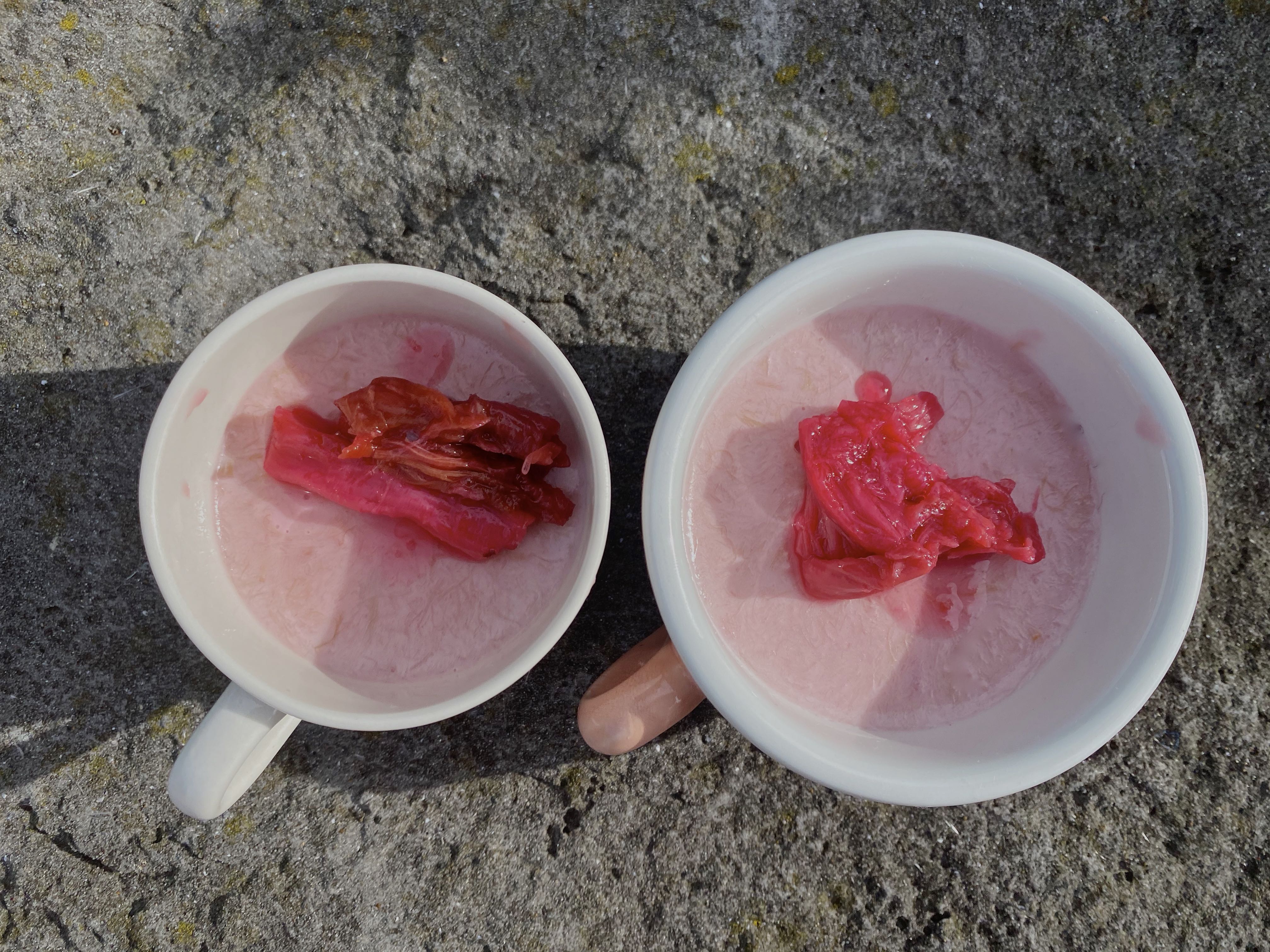
Anyway, all I was trying to say before getting quagmired in the psychological journey is that I guess I knew this was going to be delicious but I was not prepared for just how exquisite it would taste! So let’s finally get to the important part: what does this rhubarb panna cotta taste like? I could and unfortunately will say things like “sherbet cloud” and “nights in pink satin” but to be more specific, the perfumed, green apple-raspberry vibes of the rhubarb become even more pronounced when roasted and cooled; this softened fruit near-on dissolves in the cream leaving nothing but tiny threads interrupting the otherwise plush smoothness, and each thread carries within it a tiny fizzy burst of candy sourness met but not dulled by the modest quantity of sugar. Draping it with more roasted rhubarb stops it from being too mellow and importantly, adds another shade of pink: we eat with our eyes and the sheer aesthetic power of this panna cotta leaves you full up before you can blink.

IMG_8906

I’m not sure if that accurately describes them or if I’ve ended up moving even further away from my point but the point is: these panna cotta taste incredible and you should make them today. And if you can’t get hold of rhubarb? Try the passionfruit version! There’s a sour-sweet dessert for all seasons! Also, I looked up the word ‘trichotomy’ and it’s actually real: my mind is always three steps ahead even when it’s two steps behind.
IMG_8900

Vegan Rhubarb Panna Cotta

Dreamy, pink and delicious. Recipe adapted from my Passionfruit Panna Cotta, which was, in turn, adapted slightly from this recipe at anisabet.com.au. Roasted rhubarb is a method suggested in numerous Nigella Lawson books, most recently Cook, Eat, Repeat. Makes 4-5 servings.

  • 500g pink rhubarb, cleaned and trimmed
  • 1/2 cup sugar, plus 1/3 cup extra
  • 1 x 400ml tin full-fat coconut cream
  • 1 teaspoon agar-agar
  • 1 teaspoon vanilla extract

1: First, roast your rhubarb – slice each stick of rhubarb into smaller lengths, pack into a roasting dish in more or less a single layer, sprinkle over the half cup of sugar – and honestly, I didn’t actually measure it out, I just shook the bag of sugar over the rhubarb till it felt right and encourage you to do the same – then cover the tin tightly with tinfoil and place in a 180C/350F oven for thirty minutes. Allow the rhubarb to cool before decanting it, along with all the pink syrup that has formed, into a container and store in the fridge. This will make more than you need for the recipe but roasted rhubarb is always delightful to have on hand.

2: Scoop about 3/4 cup of the roasted rhubarb and syrup into a saucepan, along with the can of coconut cream and the extra 1/3 cup of sugar. Cook over low heat for a few minutes, without letting it come to a boil, stirring to break down the rhubarb.

3: Dissolve the agar-agar in a little cold water and spatula the lot into the pink rhubarb cream, stirring thoroughly to ensure there are no lumps. Keep stirring over a low heat – again, without letting it get anywhere near boiling – for another five or so minutes. It should thicken up slightly. Stir in the vanilla (you can really stir it in at any point along the way, I just remembered it now.)

4: Use a cup measure or ladle to divide this mixture between four or five small ramekins or pretty glasses. If you use four, you’ll get more, if you use five, you’ll get five panna cotta, it’s as simple as that. Refrigerate the panna cotta for a couple of hours – they set quite quickly, but I find the flavour grows stronger if you leave them overnight.

Serve with reserved roasted rhubarb and a little of the rhubarb syrup spooned over the top.

Notes:

  • Agar-agar is available at shops that sell vegan stuff and Asian supermarkets, it’s usually quite inexpensive at the latter. One teaspoon doesn’t sound like a lot to set all that liquid but it’s powerful stuff.
  • Use any leftover rhubarb on yoghurt and cereal, to top ice cream, add the syrup to cocktails, or just – make another batch of panna cotta!

IMG_8889


music lately:

Snow by Whipping Boy. I swear every dinner time a random forgotten shoegaze band will come up in conversation with my brother that I’ve never heard of and then I listen to them and it turns out they’re my new favourite band! Somehow we haven’t run out of shoegaze bands yet! This song came from Whipping Boy’s album Submarine, and I recommend listening to it all at once, but Snow has all the hallmarks of what makes the rest of the album excellent: a muffled, layered early 90s grimness coupled with remarkable, soaring beauty.

Supervixens by A.R Kane. Speaking of shoegaze; Spotify recently capitalised on the user-propelled free advertising they receive with their end-of-year listening summaries by delivering a distinctly half-hearted mid-year version, and yes, I knew I was being pandered to but unfortunately I love being told I’m special and when Spotify said: “who else but you would play Linda Eder after A.R Kane?” I was like yes, who indeed could do this? Well, now you can enjoy being special too. I’ve mentioned this song so many times on here already but I don’t care because I love it so much.

Don’t Rain On My Parade by Linda Eder. Look if you don’t have time, skip to 3 minutes and 10 seconds, the direction the notes go in compared to how utterly chill she appears to be delivering them is literally comparable to the Moon landing in terms of widespread cultural significance.

PS: If you like my writing and wish to support me directly, there’s no better way than by stepping behind the claret velvet VIP curtain of my Patreon. Recipes, reviews, poetry, updates, secrets, stories, all yours on a monthly basis.

Vegan Tofu-Fried Tofu

IMG_8446

On Friday I had my first professional driving lesson in at least ten years. People have been trying to teach me to drive one way or another since 2001; people have failed. I could not be car-broken. And in a nation of drivers, where 97% of society and its amenities are inaccessible without a car, this was eventually going to bite me. Learning about things like anxiety and ADHD has certainly helped me understand why I might not have taken smoothly to driving, but it still didn’t make me any more inclined to get behind the wheel. What I wanted was a Matrix-style chip in the back of my neck, uploading the necessary software to turn me into a driver – failing that, some kind of magic-adjacent experience, such as being hit over the head or electrocuting myself or being bitten by a spider. I did not want to do the work! Nor, should I! Why can’t society bend to me, why must we prioritise driving when it’s so dangerous and environmentally terrible and also something I can’t do?

Ten months of avoidance passed after I got my learners license (again) and then I finally booked a lesson. Unlike the other pros, this instructor was kind and patient and had heard of anxiety and didn’t just bark at me to drive into oncoming traffic; after 50 minutes concentrated figure-eighting around the nearby town, making serviceable left turns and even a few right turns, I felt unbelievably powerful and hyperactive, high on the absence of failure, almost too powerful – like, wait, can I drive now? Should I go on a cross-country road trip right now? Probably, right? Just to be safe?

IMG_8445

I bring this up for reasons twofold: firstly, I just wanted to boast that I bravely committed to learning to drive; secondly, if you’ve ever been suspicious of tofu – which I don’t respect but I do understand because we live in a society and tofu has been poorly treated in the public image – then perhaps this recipe could be the kind of successful interaction to finally make you feel like a person who not only enjoys tofu but frantically celebrates it at any opportunity. (I also recommend Bettina Makalintal’s crispy glazed tofu, I will never be without a bag of potato starch ever again.)

The recipe is Tofu-Fried Tofu, and it’s spectacularly good and inspired by Brooks Headley and his Superiority Burger Crispy Fried Tofu Sandwich. Sometimes, no matter how established the person writing the recipe, I just physically can’t follow it, and instead, I have to scan it into my head like a pdf and never read it again but use whatever key components I can remember to make a recipe based on it. Why is this? I think it’s partly the way a lot of recipes are laid out these days, and probably partly something neurological on my part, let’s be honest. The only person I don’t do this with is Nigella Lawson – at least, not as much – and I think it’s because her recipes feel as though they’re so very already in my language – whatever changes I’d make, Nigella has probably already anticipated it.

This is my roundabout way of explaining that I’m not trying to say I’m any better than Brooks Headley but I still had to make my own version inspired by his recipe rather than following it to the letter. There’s no reason why you can’t make his recipe as it’s written, I’m sure it’s amazing, and my recipe doesn’t diverge too wildly anyway. But the recipe I made is also delicious and through some trial and error, it’s exactly where I want it to be. These errors include adding cocoa to the flour mixture (I wanted to want it, but it’s not the one) and leaving the tofu at its from-the-package thickness, making for a genuinely strenuous eating experience where you practically needed a step-ladder to scale the breadth of soy protein on your plate.

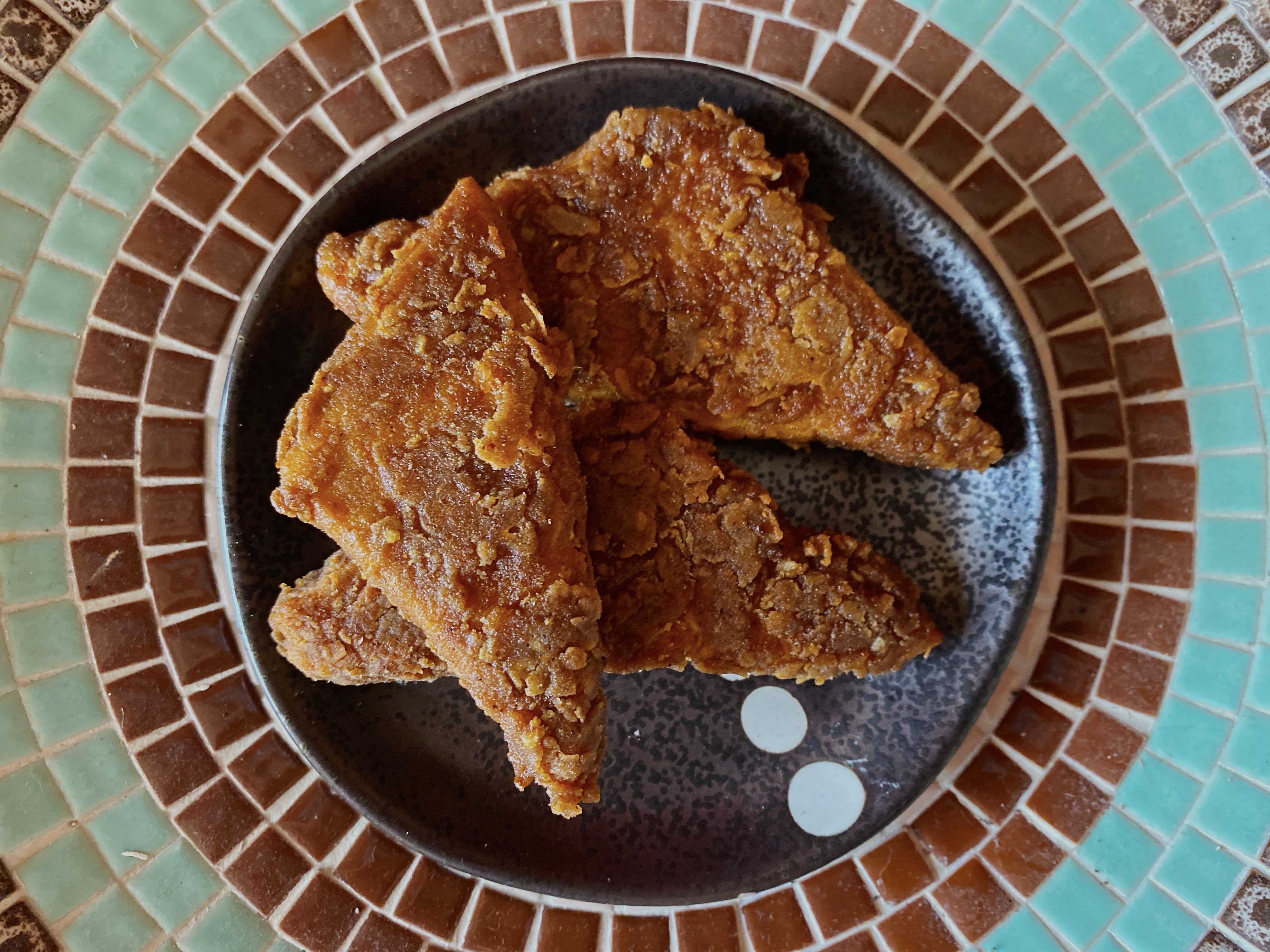
These slender triangles of tofu bathe in an aggressive marinade of pickle brine, soy milk, vegan oyster sauce or Maggi, and mustard powder – which when combined is oddly potable if not wildly delicious, I really had to bargain with myself to stop drinking it from the container while the tofu was marinating in it, I wish I were exaggerating for comic effect here but if anything I’m downplaying it. The key to the flour dredge is a ton of Chinese Five-Spice powder and ground white pepper – an inelegant ingredient but one who deserves to shine, in my opinion – and double-dunking to create pockets and crevices of crumbly coating. It’s more of a KFC-esque coating – dense and softly crisp – rather than shatteringly crunchy, especially the longer it sits, and this is obviously not a bad thing.

IMG_8434

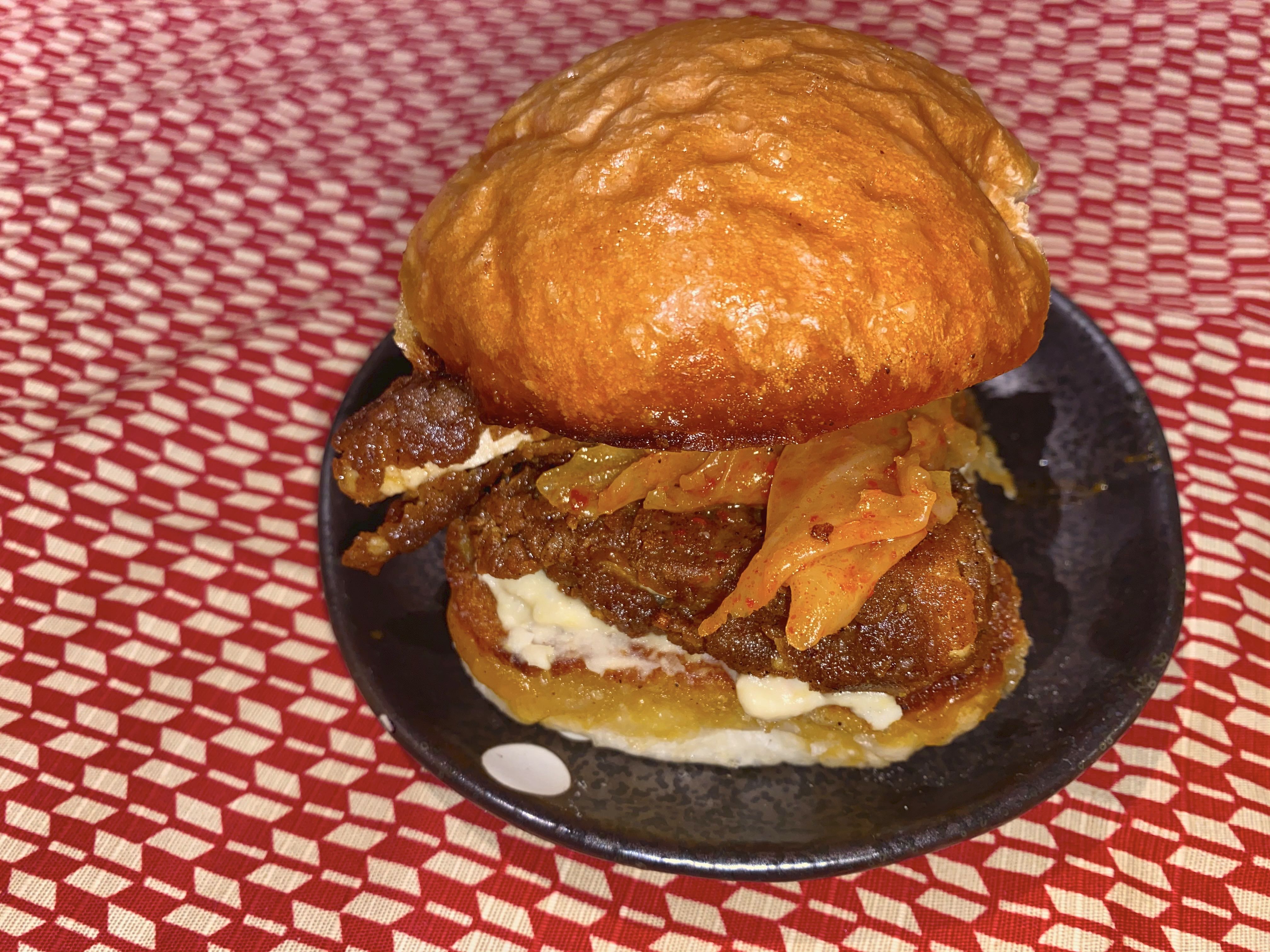
Between the tanginess of the pickle brine and mustard and the bumptious yet balanced spices, this is one of the very best things you can do with tofu. It makes sense to tuck it into a burger bun (I spread the base with hummus and topped the tofu with kimchi which was a chaotic but complementary combination) but you could serve these alongside chips or on top of rice. The crucial thing is to leave yourself a few for the next day, I honestly think they taste better cold than they do at any other stage of the proceedings.

[Also – I forgot to mention this last week but I had the joy of appearing on Pip Adam’s Better off Read podcast to discuss the plot devices I employ in my poetry, the way I’m influenced by film auteurs in my fiction writing (does this make me an auteur? Maybe??) and more besides; Pip is one of my very favourite writers and it was such an honour and a thrill to speak with her about writing. It’s just really fun and I thoroughly recommend you listen to it because I’m a great podcast guest and she’s a great host!]

IMG_8467

Tofu-Fried Tofu

This is inspired by Brooks Headley’s recipe, and the more often you make it the less effort it will seem. I can’t tell you how delicious this is cold from the fridge the next day. Makes 12 pieces.

  • 1 x 300g (or thereabouts) block of tofu, firm or extra-firm
  • 1/3 cup brine from a jar of pickles/gherkins
  • 1/2 cup soy milk (or oat milk – I wouldn’t use anything other than these guys though)
  • 1 tablespoon mustard powder
  • 1 tablespoon vegan oyster sauce, Maggi seasoning sauce, or soy sauce
  • 2 cups flour
  • 3 tablespoons cornflour
  • 5 teaspoons Chinese Five-Spice powder
  • 1 tablespoon smoked paprika
  • 1 tablespoon garlic powder
  • 1 teaspoon ground white pepper
  • a large pinch of salt
  • 1 teaspoon dried celery (if you can get hold of it)
  • neutral oil, such as rice bran, for frying

1: If you have the time, freeze the tofu for at least a couple of hours and then allow it to defrost – this does something wonderful to the texture, but if you forgot or can’t be bothered – or just got home and want to eat this as soon as possible – don’t worry, it’ll still taste good with tofu straight from the fridge.

2: Place the pickle brine, soy milk, mustard powder, and vegan oyster sauce in a rectangular container a little larger than your block of tofu and whisk to combine. Drain any liquid from the tofu and slice it across diagonally, so you have four triangles, then sit each triangle on their longest side and slice through them twice with the knife flush with the flat side, so you have three of that same triangle, just a lot thinner/flatter. You’re cutting pages, not wedges. I hope that description makes sense – basically, you want to go from having those four triangles to having three matching sets of those triangles, which you can stack up again back into the original rectangle. If it still doesn’t make sense, watch the TikTok above and you’ll see how I cut it there.

3: Place the tofu into the container of marinade, stacking them up into their original rectangle shape, and leave for a couple of hours (although I’ve made this with only about half an hour of marinating and it still tasted good so once again, if you’re impatient or didn’t plan a single thing, it’ll work out.)

4: In a mixing bowl, combine the flour, cornflour, Chinese Five-Spice powder, smoked paprika, garlic, pepper, salt, and dried celery if you’re using it.

5: Drop each tofu triangle into the flour mixture, then dunk them back in the pickle marinade, then coat in flour again. This is messy, there’s no way around it, but if you just use one hand it’s at least contained, you know?

6: Pour a thin but definite layer of oil into a large saucepan and once it’s hot – when bubbles form around a spoon or whatever you stick into it – cook the tofu slices for a few minutes on each side, flipping twice. Also, this might sound weird but if you have any leftover flour mixture, stir in a little marinade and fry this dough in the hot oil too as a little cook’s treat. It’s really good and I don’t care!

7: Transfer the cooked tofu to a rack with absorbent paper on it and either use immediately, or you can store them in an airtight container in the fridge and briefly fry on each side to heat through. They’re best either straight from the pan or dead cold from the fridge, but this in-between stage is also very commendable.

Notes: As you can see, there are some aspects of this recipe you can be loose about and some which I think are very important. I’d like to emphasise that you absolutely cannot leave out the Chinese Five-Spice and the pepper has to be white – but if you only have a quarter of a cup of pickle brine left in your jar or if you accidentally pour half a cup, nothing bad is going to happen. Sometimes I add a little pinch of baking powder to the flour mixture, this time I forgot, either way is fine. Also, I realise two cups of flour sounds like a lot, but you end up needing it all to confidently double-dunk the tofu. Finally: I don’t know if you can bake or air fry this and I don’t want to find out! The oil is as important an ingredient as anything else on the list!

IMG_8448

music lately:

For The Love of Ivy by The Gun Club. Rhyming “hell” with “hell” four times in a row? Going loud then quiet then loud? That’s the ticket!

Matthew and Son by Yusuf/Cat Stevens (he goes by both names these days, I checked) this song is disarmingly goofy and has the distinct air of being accompanied by a high school orchestra and it’s nowhere near as cool as any of his other songs so naturally, it’s my favourite thing that he’s ever done. It is what it is!

When Love Goes Wrong, Nothing Goes Right, by Marilyn Monroe and Jane Russell from the film Gentlemen Prefer Blondes, I haven’t seen this film in years but was reminded – on TikTok! – of how charming this number is and how crackling the chemistry is between Monroe and Russell. Their harmonies when the song speeds up a notch – “a man goes out, gets high as a kite” – are glorious. I will absolutely be rewatching this film soon.

PS: If you like my writing and wish to support me directly, there’s no better way than by stepping behind the claret velvet VIP curtain of my Patreon. Recipes, reviews, poetry, updates, secrets, stories, all yours on a monthly basis.

rum and coke jackfruit

IMG_8025

The notes app on our phones and its contribution to our general existentialism cannot be overstated – it’s our id and ego condensed, an unkempt filing cabinet of shopping lists and auspicious dreams, of half-written poems, funny bits, bullet points, log-in details, recipes, addresses and other arbitrary ephemera.

(If this doesn’t make any sense: the notes app is a function on most smartphones that acts as a notebook for you to jot down literally anything – usually to forget about it immediately – and there’s also a good chance I’ve misused the word “existentialism” here but whatever, it’s the vibe of the thing.)

Because I ricochet from one thought to another like an earnest pinball, and every last one of these thoughts seems terribly meaningful, my notes app is rather busy. And because each note is filed away forevermore until you delete it, I’m always finding stuff I absolutely do not remember writing.

Like this note: “rum and coke jackfruit”.

IMG_8012

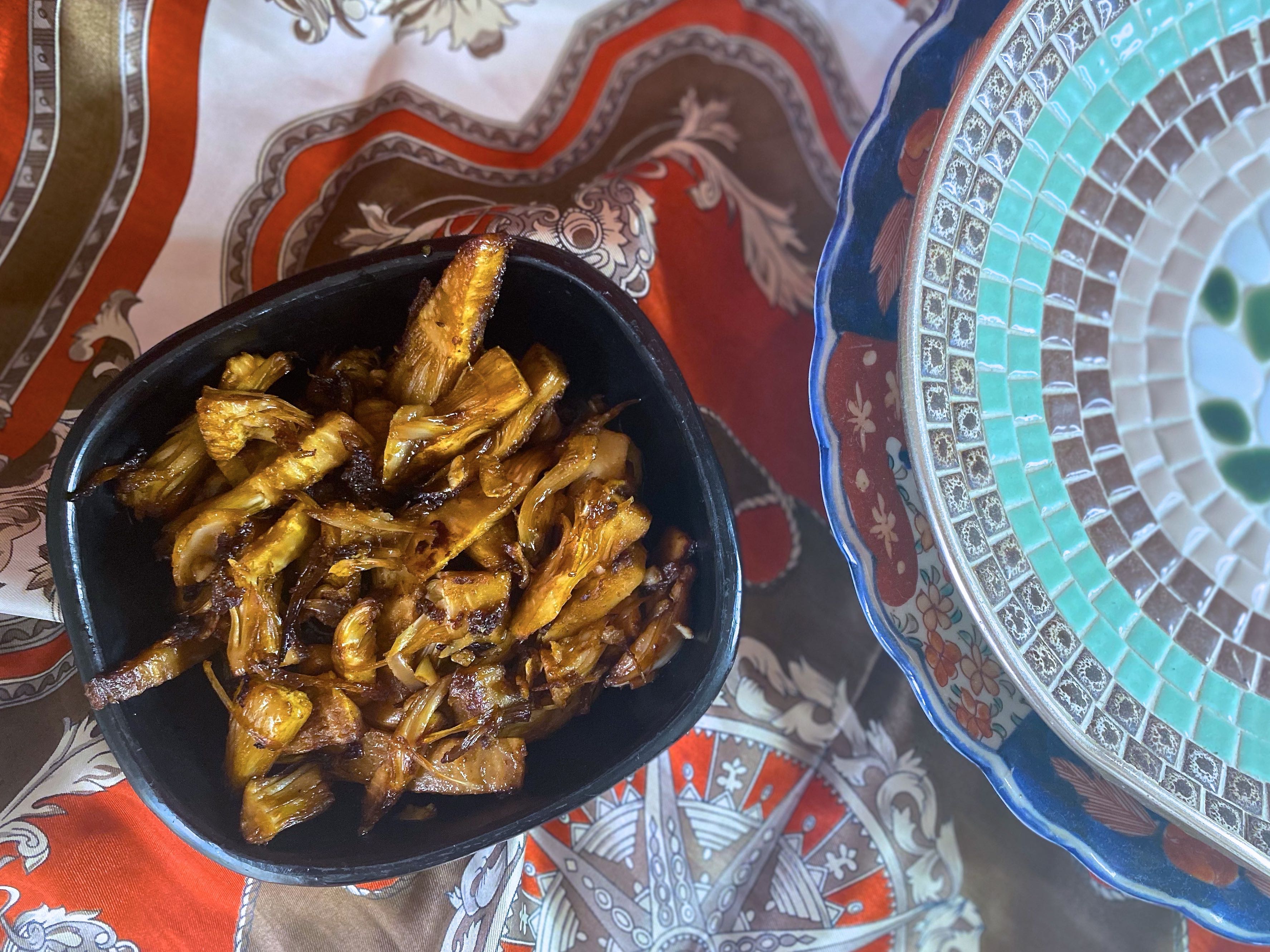
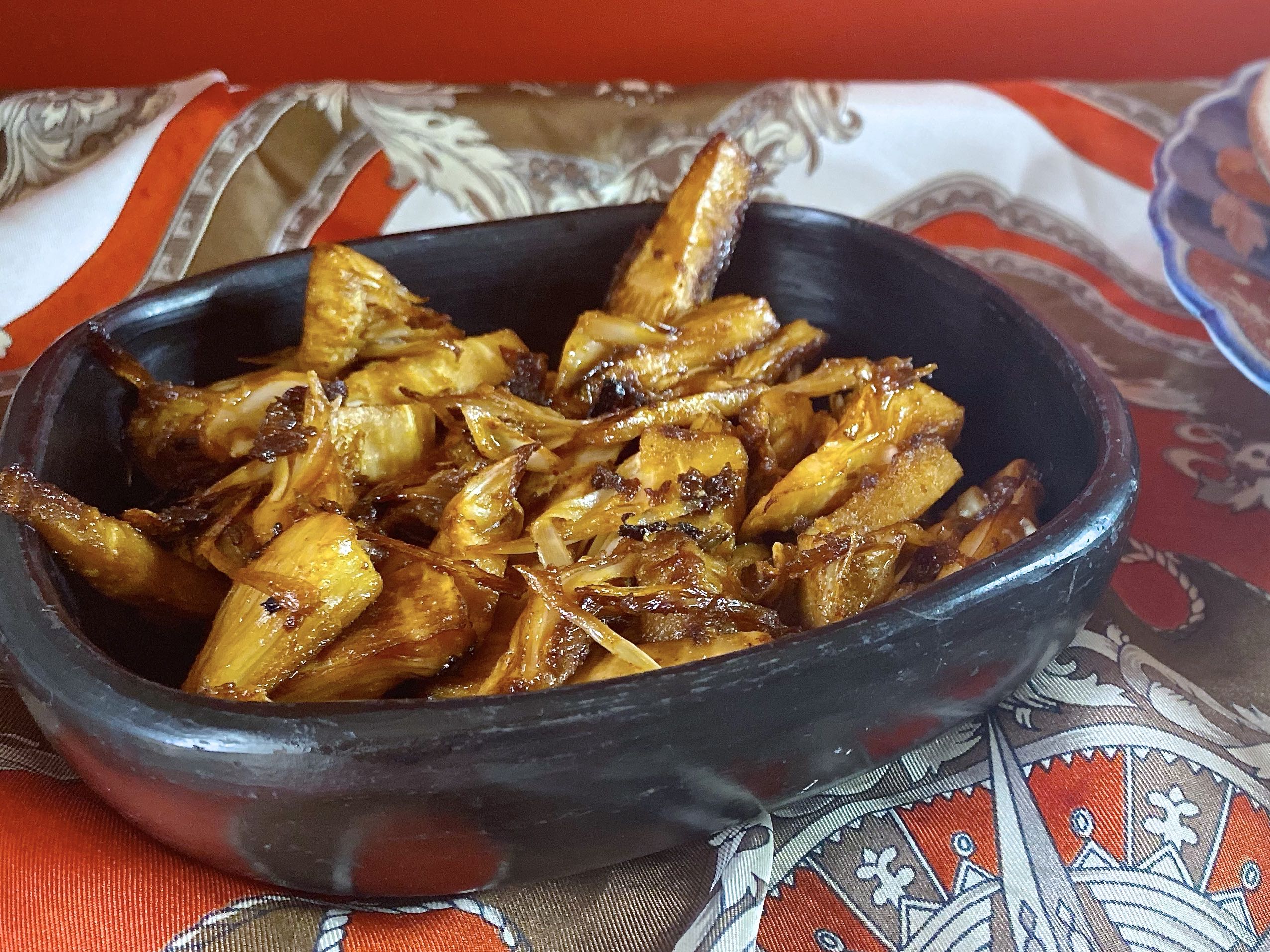
I don’t remember writing it – although evidently, I did at some point – but having found it, I decided to make good on this long-ago reminder to myself, and so we have this week’s recipe, based on that promising prompt. Jackfruit is a large fruit present in the cuisine of numerous cultures, including Bangladesh and Sri Lanka for whom it’s the national fruit, and South India and Southeast Asia. Over the last few years, it’s become increasingly common in NZ supermarkets canned in brine, which makes it straightforward to use, and its superb texture – dense, softly fibrous – and sweetly mellow flavour makes it ideal for vegan cooking.

Rum and Coke are both sweet, and somehow spiced without being spicy – and together they plus a few other ingredients create a sticky, saucy coating for the jackfruit under the heat of the oven’s grill. Now, if you were to taste this wearing a blindfold I don’t know if you could confidently name either ingredient, and if I’m very honest the rum is mostly just window-dressing because the come-hither familiarity of the title is cute – but nonetheless, this is monumentally appealing, with the smokiness from the paprika, earthy cumin, and plenty of garlic. And despite the length of the recipe, it’s easy too – a bit of simmering, a bit of scorching in the oven, and it’s all yours, to be draped over rice or tucked into tacos and sandwiches.

@hungryandfrozen

my best loop yet 🥲 Rum and Coke Jackfruit, recipe @ hungryandfrozen.com 🤠 #recipe #vegan #veganrecipes #jackfruit #foodblogger #cooking #fypシ #fy

♬ Bluebirds Over the Mountain – Richie valens

This sauce mix – by which I mean everything minus the chicken stock and jackfruit – would be excellent coating other star ingredients as well, with its general barbecue-ribs-flame-grill mood – tofu, obviously, or seitan would be great, but I think oyster mushrooms would be even better. I based the method on the pulled jackfruit recipe I made back in 2017 – before I was vegan but tentatively contemplating it – and I enthusiastically recommend you make that one too. It’s true for both recipes: no matter how much jackfruit I cook, I always wish I’d made more – you’d better write “two cans of jackfruit” in your notes app, to be safe.

IMG_8023

Rum and Coke Jackfruit

Sticky, smoky and sweet, this vegan jackfruit is perfect over rice, in tacos, in sandwiches – basically wherever you want something extremely delicious. Recipe by myself.

  • 1 x 500g can jackfruit in brine (300g drained weight)
  • 1 cup vegan chicken stock (eg 1 cup water, 1 stock cube)
  • 4 cloves garlic
  • 3 tablespoons olive oil
  • 1 teaspoon mustard powder
  • 1 teaspoon cumin
  • 2 teaspoons smoked paprika
  • 2 teaspoons coconut sugar (or brown sugar)
  • a pinch of cinnamon
  • 2 tablespoons soy sauce
  • 1 tablespoon dark rum
  • 1/2 cup coca-cola
  • 1/2 teaspoon cornflour (cornstarch)

1: Drain the liquid from the can and roughly chop each piece of jackfruit into smaller pieces lengthwise. Don’t worry if there are any seeds – leave them in.

2: Place the jackfruit pieces, the chicken stock, and the unpeeled garlic cloves into a saucepan and simmer for ten minutes. Simmering the garlic cloves like this gives them a more mellow flavour and makes them easy to peel later.

3: While this is happening, turn your oven to 200C/400F, pour the olive oil into a roasting tray, and place it in the oven to heat up.

4: In a small bowl, mix together the mustard, cumin, paprika, sugar, and cinnamon. Stir in the soy sauce, dark rum, coca-cola (it’ll fizz up a little) and the cornflour.

5: After ten minutes, drain the stock from the pan of jackfruit (you can save it for later use, I’m not advocating wastefulness here.) Press down on the garlic cloves to release them from their skins and roughly chop them. Return them to the pan of jackfruit along with the coca-cola/spice mix and stir to combine.

6: Remove the hot roasting dish from the oven. Transfer the jackfruit mixture onto the roasting dish – I recommend using tongs to ferry the jackfruit pieces across before pouring the remaining liquid over rather than just dumping the contents of the pan onto the roasting dish because it will splutter when the liquid hits the hot oil.

7: Place the tray in the oven and leave for twenty minutes. At this point, remove the tray, turn the jackfruit pieces over, switch your oven to the grill/broil function and grill for a further ten minutes, keeping an eye on it to make sure it doesn’t scorch too much. By this point, the liquid should have evaporated and the jackfruit should be burnished brown at the edges.

8: Serve immediately, although you can store it in the fridge and reheat it in a hot pan if need be.

Serves – well that depends on how you serve this. It fed four as part of a rice bowl, but if I was having it with fewer extra bits I wouldn’t want to make this for any more than two people, and one person could eat the lot very easily. Making double would be sensible (in which case I’d only increase the liquids by about half – eg 1/2 cup coca-cola becomes 3/4 cup – but the spices can be fully doubled.)

Notes:

  • If you don’t have rum or don’t wish to use alcohol in the recipe, that’s all good – just add an extra teaspoon of sugar. I wouldn’t make this if I only had white rum in the house, but spiced rum could be interesting.
  • Feel free to add your preferred form of chilli to this recipe – my family’s taste tends towards the mild, but if I was making it just for myself a little gochujang wouldn’t go amiss.
  • I suspect diet Coke or Coke Zero wouldn’t have the same effect here – you need the sugar to make it work.

IMG_8022

music lately:

Pretty Little Angel Eyes by Curtis Lee. I’ve had of late an odd nostalgia for the songs used in my jazz dancing classes in the early nineties – those hard-working cassette tapes dubbed from other tapes by my teacher. This song was one which we danced to, and despite its chirpy lyrics and break-neck pace – I’m not sure it actually has any verses? It’s literally all bridge? – there’s something about that doo-wop sound that makes me feel super melancholy the minute the “woo-ooo-ooo” bit starts. Anyone else?

Overload by Zappacosta, another song on high rotation in my jazz-dancing years – and I’m sorry to sound ancient but WHY don’t songs sound like this anymore? When will people be brave enough to do that? Is it so much to ask?

SpottieOttieDopaliscious by Outkast. Everyone mentions the horns first – and they’re the greatest – but I also harbour deep affection for that “damn, damn, damn James” refrain. This song is seven minutes long and it feels like three – honestly, forty minutes would still leave you feeling bereft the moment it ends.

PS: If you like my writing and wish to support me directly, there’s no better way than by stepping behind the claret velvet VIP curtain of my Patreon. Recipes, reviews, poetry, updates, secrets, stories, all yours on a monthly basis.

Roasted Carrot Cake with Apple Cider Vinegar Buttercream [Vegan]

IMG_7011

I love coming up with recipes – but I especially love when the recipe which appears in my head has an immediately iconic vibe, a “this will come to define you and you’ll thank it for the honour” vibe. Not every recipe has to relentlessly imply historical significance, that would be exhausting. It’s fine for some recipes to be merely excellent rather than One For The Ages – more Tony Awards red carpet than Met Gala – but when you know, you know. And as soon as this Roasted Carrot Cake entered my head: I knew. She’s a star.

Unfortunately, the first time I made it I couldn’t get the cake out of my head into the oven – the roasted carrot aspect of it was great, delicious, inspired, but the texture was okay at best. I scribbled some notes, I moved proportions around like a small prodigy at their chessboard, I put it aside. I then, with some ailing bananas, made these Banana Crumb Muffins from The Minimalist Baker – and the excellent results gave me the idea which saved the cake: more baking soda. (And then, upon looking at the cake I make the most, my Mocha Cake – well, that has two teaspoons of baking soda too. Turns out the answer was in my heart all along.) You might think two teaspoons sounds like too much, but it works and it’s exactly what the ingredients needed to spring together and form a dense, moist, rich carrot cake. 

IMG_7002

What makes this cake especially amazing is, of course, the roasted carrots. I’ve spoken enthusiastically and at length about my love of the fried or roasted carrot – in THE Fried Carrot Noodles, this Kale, Pecan and Fried Carrot Salad, and this Roasted Carrot Mac’n’Cheese. This cake is the zenith of my carrot preoccupation – although perhaps it’s recency bias talking – but it makes sense, right? The toasty, nutty depth of flavour and sweetness which comes from applying oil and high heat to your carrots would surely benefit a cake! In fact, I don’t know how it didn’t come to me sooner.

Roasting the carrots does add an extra step to this recipe, but you have to heat up the oven anyway, and besides, I’d rather wait around for carrots to brown than spend even a millisecond grating them. And from one extra step, you get this glowing, fulsome carrot flavour that the mere raw vegetable on its own could only dream of. It’s truly a perfect carrot cake – dense, hefty, yet light and cup-of-tea-friendly; warmed up with cinnamon and nutmeg and draped in a zingy buttercream. The buttercream uses the quick-emulsion method I devised – also iconic, as befits a cake like this – which I’ve made in various iterations before, such as these cupcakes and the aforementioned mocha cake. Here I’ve added a little more apple cider vinegar to give it a zingy bite – not too sharp, I mean, there is all that icing sugar – and its presence is vital and necessary. Yeah, you could get away with not having the icing but a fridge-cold slice of this carrot cake – feeling your teeth slide through the fudgy, wet-sand texture of the buttercream into the damp crumbs of cake and softly crunchy walnuts below – it’s honestly quite unreal.

IMG_7021

Roasted Carrot Cake with Apple Cider Vinegar Buttercream

An incredible vegan carrot cake: moist, dense, rich, but light, with a zingy buttercream. The ACV gives all that sugar a necessary sour edge, but I promise it doesn’t end up tasting like salad dressing – if you’re really not sure though, use lemon or lime juice instead. Roasting the carrots gives them a nutty depth of flavour – a little extra work – and so worth it. Recipe by myself.

  • 400g carrots (roughly four medium carrots, don’t worry if it’s a bit over or under)
  • 1/4 cup olive oil, plus extra
  • 2 tablespoons chia seeds
  • 1/3 cup water
  • 1/2 cup brown sugar
  • 1/2 cup white sugar
  • 2 tablespoons golden syrup (or treacle, or molasses – in which case reduce it to one tablespoon)
  • 1/4 cup soy milk
  • 2 teaspoons baking soda
  • 1 teaspoon cinnamon
  • 1/4 teaspoon nutmeg
  • 1/2 cup walnuts, roughly chopped or broken into small pieces
  • 1/2 teaspoon salt
  • 1 and 1/2 cups plain flour

1: Set your oven to 200C/400F. Scrub the carrots (no need to peel) and chop them into sticks. Place in a roasting dish with the olive oil and roast for fifteen to twenty minutes, until the carrot sticks are tender and slightly browned in places. (You can turn your oven up higher if you want, but keep an eye on them.)

2: While the carrots are roasting, place the chia seeds and water in a mixing bowl and let it sit for a few minutes till the chia seeds have swollen and absorbed most of the liquid.

3: Stir the brown and white sugar, golden syrup, milk, baking soda, spices, walnuts and salt into the chia mixture, and beat well to thoroughly combine.

4: Remove the roasting dish from the oven and lower the heat to 190C/375F. Line a loaf tin with baking paper.

5: Use tongs to lift the carrots onto a chopping board (you’ll probably need to do this in batches) and chop them roughly but finely. A large heavy knife and a rocking motion – as though you were finely chopping herbs – are useful here. You could pulse the carrots in a food processor till they’re roughly yet finely chopped but that’s a whole extra thing to wash – it’s up to you. Transfer the chopped carrots to the mixing bowl and continue till they’re all chopped. Tip any remaining olive oil from the roasting dish into a 1/4 cup measure, and top up with extra olive oil till the measuring cup is full. Add this to the mixing bowl and stir to combine.

6: Add the flour to the mixing bowl and gently fold it together – don’t overmix. Spatula the cake batter into the waiting loaf tin, and bake for about thirty-five minutes – although it may need a little longer, depending on your oven. You may need to cover it with tin foil towards the end if it appears to be browning too much – again, this depends on your oven. Once it’s done, remove it from the oven and let it cool before frosting with the buttercream.

Apple Cider Vinegar Buttercream

  • 3 generous tablespoons refined coconut oil, soft but not liquid
  • 3 tablespoons soy milk, plus extra if needed
  • 1 teaspoon apple cider vinegar
  • pinch salt
  • 1 and 1/2 cups icing sugar

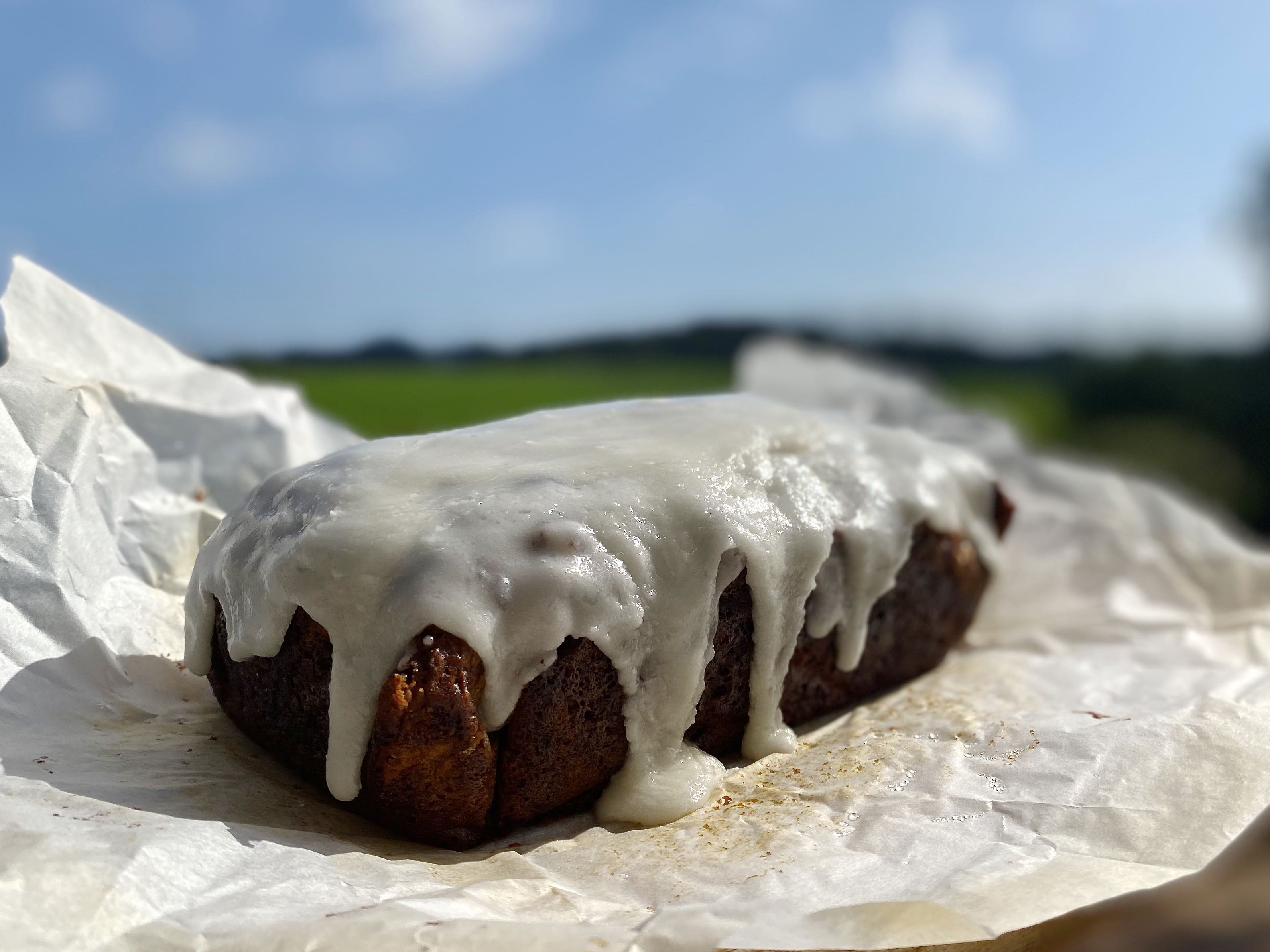
1: Beat the coconut oil, milk, cider vinegar and salt together in a small mixing bowl with a wooden spoon. Don’t worry if it looks a little unlikely! Stir in the icing sugar (sieving if you have the energy) to form a thick, pale buttercream. Add a splash of extra milk if it’s too thick. Spread over the cooled cake. (I, of course, absolutely couldn’t wait for it to cool, which is why the photos show the buttercream running down the sides of my cake.) 

Store the cake in an airtight container in the fridge. It tastes better and better upon sitting for a day, I’m afraid to say.

Note: while this is my recipe, it was making these delicious Banana Crumb Muffins from Minimalist Baker which gave me the idea to boldly increase the baking soda. (I definitely recommend making the muffins, too.)

IMG_7023

music lately:

Party Up (Up In Here) by DMX – Man, I’m so sad about his passing. Like, he’s got poignant songs, and it’s impossible to hear the whistles at the start of Party Up without wanting to triple somersault from a diving board landing in the splits in the centre of the dance floor, but this is the one I wanted to hear most today.

I’m a Stranger Here Myself by the queen of Golden Age Broadway Mary Martin from the 1943 Kurt Weill musical One Touch of Venus. I don’t know how this song hasn’t become more of a standard – it certainly comes out the gate confidently sophisticated and arch – but there just aren’t that many cover versions of it (Kristin Chenoweth’s is charming, though.)

Venus in Furs by The Velvet Underground. Almost irresponsibly phenomenal? And I know I repeat this mild anecdote every time I mention this song but in 2006 I briefly worked in a German bakery and one day I was playing this song on loop on the little stereo and my boss pulled up in front, walked in, turned it off, walked away and drove off all without saying a word.

PS: If you enjoy my writing and wish to support me directly, there’s no better way than behind the claret velvet VIP curtain of my Patreon. Recipes, reviews, poetry, updates, secrets, stories, all yours on a monthly basis.

The Best White Bread [vegan]

IMG_5010

There’s this twitter account dedicated solely to posting, every Friday, a brief clip of actor Daniel Craig announcing musician The Weeknd on Saturday Night Live, and though I don’t follow this account, every seven days enough of the people I do follow force it onto my timeline through their retweeting, and because time has become gelatinous and meaningless I seem to encounter this tweet at ever-shortening concentric cycles, though I understand a week is still seven days despite my perception of it being something much smaller. Anyway, the specific way the actor Daniel Craig says “Ladies and gentlemen: The Weeknd”, with this air of resigned gratefulness – with unabashed yet just faintly bemused gravitas – so moved by that which he is announcing – with his arms stretched wide and his head shaking in appreciative disbelief – his arms which say everything his mouth cannot – well, that’s the only way I can talk about this recipe. It’s the best bread I’ve ever made, it’s the best bread you’ll ever make, there’s nothing more that can be said, not by me, not by Daniel Craig, not even by Daniel Craig’s arms.

IMG_4996

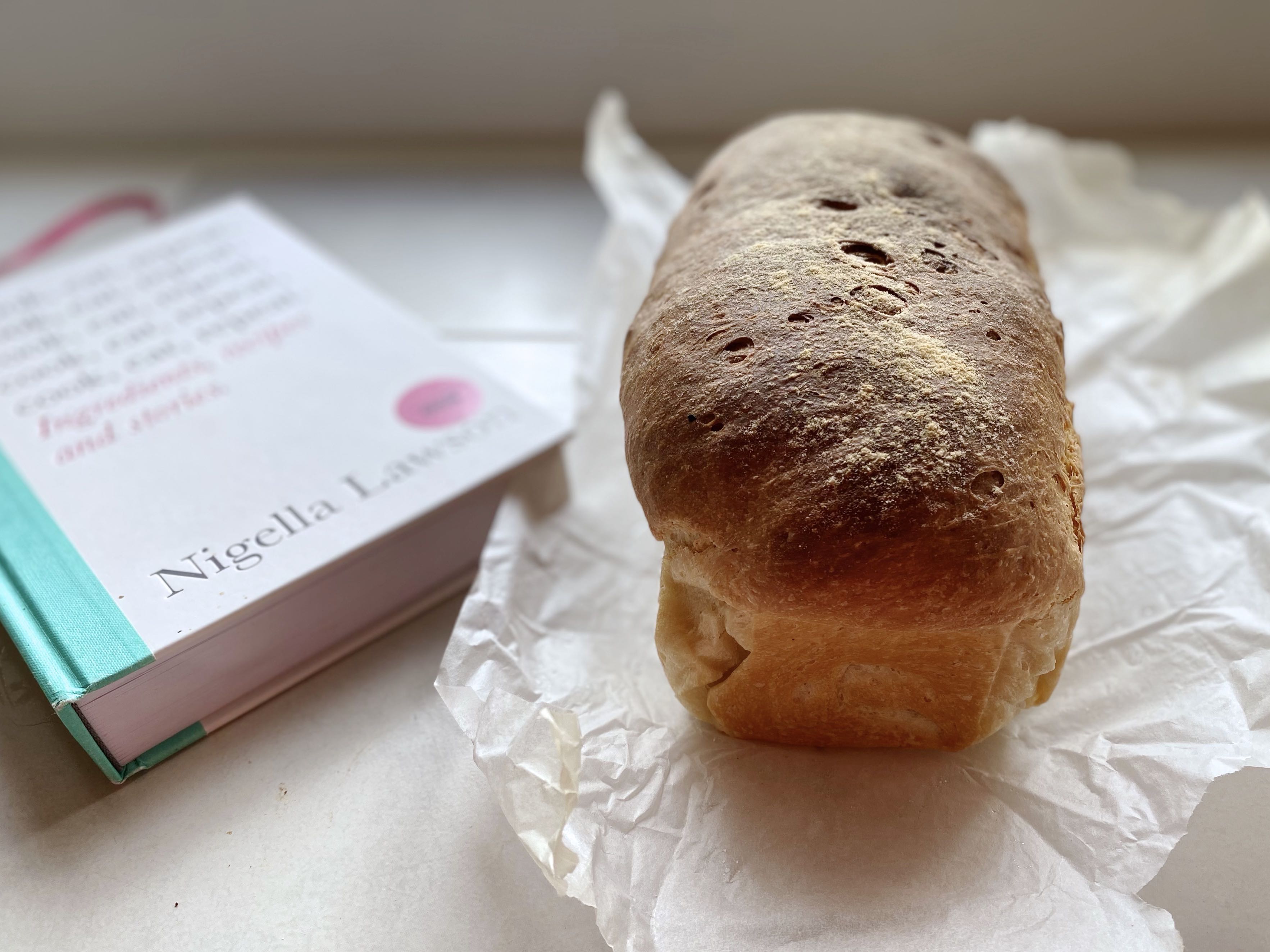
It would, however, be failing the very concept of a food blog to imply nothing can actually be said about a recipe. And I’d be failing myself because I never miss an opportunity to over-explain. So here we go. This recipe comes from Nigella Lawson’s most recent book, Cook, Eat, Repeat, a soothingly expansive volume with essays that fluctuate into recipes and vice versa, and it’s the recipe I’ve made most from it thus far – in fact, it’s probably the recipe I’ve made most this year full stop. I’ve enacted some small changes to make Nigella’s recipe vegan – replacing the spoiled milk or sour cream with soy milk curdled by apple cider vinegar, the acid of which I believe has a spectacular effect on the airy crumb of the resulting loaf; I also use refined coconut oil instead of butter, since it bears a buttery flavour and has a similar melting temperature. Other than that, the recipe remains hers, via the chef Dan Lepard, although I only just realised – after having made this recipe countless times this year – that Nigella offers her own vegan option (using almond-soy yoghurt and vegetable shortening) in the book? I’m baffled at how I missed that extremely relevant detail, but that’s ADHD for ya I guess. What sets this bread apart from other methods is the on-off process of kneading for ten seconds and letting it rise for ten minutes – somehow these incredibly brief bursts of agitation make the dough flourish and swell like an inflated bouncy castle.

IMG_4994

I’ve made numerous loaves of bread in my time – recipes of mine, of Nigella’s, recipes ancient and modern, but nothing has ever knocked me clean off my feet quite like this one. It’s so light and soft, and crisp-of-crust, and perfect, the sort of bread the Famous Five would take to an island to eat while fighting crime (it’s a while since I’ve read any Enid Blyton and I may be conflating some storylines here), the sort of bread Da Vinci himself would’ve come up with had he devoted himself to baking instead of art and invention, it’s like finally realising a sublime dream you didn’t quite know you’d been chasing your entire life, and you know what else?

IMG_5001

It slices up a treat. The importance of this aspect cannot be overstated! The knife melts into the crust and peels away clean slice after clean slice without the slightest squashing – you can rest your hand squatly on top of the loaf to steady yourself as you cut with confidence that you’re not going to immediately flatten it like an old air mattress. Even I – someone who can normally only carve diagonally, producing great wide-hipped triangles of bread – can cut thin elegant sandwich-ready slices from this, mere minutes after it leaves the oven.


@hungryandfrozen

the BEST loaf of bread you’ll ever make 😍😩 🍞 recipe at hungryandfrozen.com 🤠 #nigella #nigellalawson #recipe #foodblogger #fyp #bread #vegan

♬ Happy When It Rains – The Jesus And Mary Chain


Set aside a day and make this recipe. Soon enough you’ll be wandering around, arms outstretched, saying “Ladies and gentlemen: this bread!” in a resonant and impassioned voice to anyone who will listen.

IMG_4998

The Best White Bread

Lightly adapted – by which I mean this is now vegan bread – from Nigella Lawson’s Old-Fashioned Sandwich Loaf in Cook, Eat, Repeat. This is simply the best loaf of white bread you’ll ever make, and worth every minute of the rise time. 

  • 500g strong white bread flour (also called “high grade”)
  • 2 and 1/2 teaspoons instant dried yeast
  • 1 tablespoon sugar
  • 2 teaspoons fine sea salt or 1 teaspoon regular table salt
  • 125ml (1/2 cup) soy milk
  • 1 teaspoon apple cider vinegar
  • 150ml cold water
  • 100ml water from a just-boiled kettle
  • 3 heaped tablespoons soft/room temperature refined coconut oil

1: Place the flour, yeast, sugar, and salt in your biggest mixing bowl – this dough needs plenty of space to rise.

2: Pour the soy milk and apple cider vinegar into a measuring jug and leave it for a minute to curdle. Then add the cold water, followed by the hot water from the just-boiled kettle (might as well make yourself a cup of tea while you’re there) and stir the coconut oil into the jug. It doesn’t matter if the heat from the liquid doesn’t totally melt the oil. (If you can’t work out how to measure the 100ml and 150ml water – which falls outside of regular cup measurements – you can weigh the water on the scales you used for the flour, as 1g = 1ml.)

3: Pour the wet ingredients into the mixing bowl and stir briefly to combine. Form into a rough ball and cover the bowl with plastic wrap or, more sustainably – as per Nigella’s suggestion – a shower cap. I hope you don’t need me to tell you that it should be new and unused. Leave the dough for ten minutes.

4: Remove the plastic covering and knead the dough for ten seconds. You can do this on the kitchen counter, I prefer to do it inside the bowl to save on cleaning. Either way, it helps to put a little oil on your kneading hand to stop the dough from sticking to you as you push the dough away and pull it back to you. Cover the bowl again with the plastic wrap, and leave for ten minutes. Repeat this ten-seconds-on-ten-minutes-off step twice more.

5: After the third ten-second knead, form the dough into a ball, cover the bowl again with the plastic wrap, and leave for an hour to rise. Don’t worry about having it somewhere warm unless your house is especially freezing and draughty (which in New Zealand is, alas, highly likely.)

6: Lay a sheet of baking paper on the bench and tip the risen, puffy ball of dough onto it. Oil your hands again, press the dough into a rectangle shape about an inch thick (I have never once measured this step so don’t worry too much) then roll the dough up into a scroll, carefully shift it into the centre of the piece of baking paper, then lift the dough up by picking up the paper on either side of the dough scroll, and lower it all into a loaf tin, which should leave you with a loaf tin, lined with baking paper, and filled with dough. I hope these instructions make sense – the Tiktok video above gives a visual of what I mean – also Nigella’s recipe tells you to line the loaf tin with paper first and then pick up the dough directly with your hands, and you can, of course, follow this reasonable request instead of mine. Leave the tin-bound dough for one final rise of about an hour to 90 minutes, until it’s billowing over the top – I usually drape the same plastic wrap from the bowl loosely over it just to protect it from local marauding insects, depending on your location this may not be an issue.

7: Once the dough looks like it’s nearly done rising, turn your oven to 200C/400F. Dust the top of the loaf with a little flour, and bake for 45 minutes. I’ve never had to bake it for any more or any less, but I would suggest placing it fairly low in the oven because it does continue to rise and can scorch a little on top if it’s too close to the heat. Store wrapped in a clean tea towel.

Note: As I mentioned before, I somehow? Didn’t realise Nigella offers her own vegan alternative in the lead-up to this recipe, despite having made this so many times I just…completely missed it. She suggests using almond-soy yoghurt and vegetable shortening and I have no doubt this would yield excellent results. 

IMG_5012

music lately:

Loveless by My Bloody Valentine – one of my utmost favourite albums – is finally back on Spotify after a long and parched time away. You really need to listen to it all at once, preferably lying down.

Bless Your Beautiful Hide by Howard Keel from Seven Brides For Seven Brothers. Keel really found his niche playing brawny scoundrels who were startlingly sexist even for the time period, who were constantly striding about in tight trousers insisting someone marry him (he sang a near-identical song, vibes-wise, in Kiss Me Kate) all of which should not give me cheer whenever he appears onscreen and yet! That tall man has undeniable charisma rolling off him in waves and the kind of river-deep baritone we regrettably don’t value anymore and no matter what hackneyed nonsense he’s singing, his sheer talent makes it incredibly riveting.

Shy Guy by Diana King. It’s so timeless and electrifying, and that bridge! A truly top-tier bridge (closely followed by the one in Lisa Stansfield’s All Around The World). Wherever you hear this song will instantly become a dance floor.

PS: If you enjoy my writing and wish to support me directly, there’s no better way than behind the claret velvet VIP curtain of my Patreon. Recipes (including this one, back in January!) reviews, poetry, updates, secrets, stories, all yours on a monthly basis.

tomatoes and fried mint (vegan)

IMG_6507

Prevailing modern wisdom suggests the best way to cook is by taking the highest-quality seasonal ingredients and doing as little as possible to them. Which is fine, admirable, whatever, but I would go one further and propose that the best thing to do with these seasonal ingredients is to fry them. How better to show your respect to anything than by dousing it in hot fat? Especially if, like the Spanish inquisition, the frying is unexpected! We’ve all heated up a tomato. Have you ever tasted fried mint?

IMG_6480

We’re blessed with several containers of glowing-ripe tomatoes from the garden, which magically refill as soon as they’re emptied, and I kept thinking about these tomatoes with fried mint, about how the leaves would go crisp and crunchy and the oil they’d sizzled in would become infused with their heady scent. It’s very possible, highly likely in fact, that I read about fried mint somewhere and internalised the idea – but it appeared in my head out of nowhere, compellingly, and I had a feeling it would be spectacular. That feeling was confirmed. I hesitated before including this recipe on here – I say recipe, it’s more of a vaguely-realised suggestion, a bullet point in the notes app of your phone at best, but it tasted incredible and it’s been forever since I’ve posted savoury, and as the late, sorely missed Anthony Bourdain said in Kitchen Confidential, “Good food is very often, even most often, simple food.” (For some reason I always misremember that book as being called Secrets and Knives, in fact, I was convinced one of his publications had that title; if there’s a doctor in the house I’d love to know if “constantly getting kneecapped by the Mandela effect” is something I can get a pill for.)

IMG_6485

With a recipe so simple as to be almost nonexistent you need good tomatoes, sweet and pendulous, the kind to make your eyes fly open as you bite into them, perhaps followed by an exclamation of “hell’s bells!” I wouldn’t really recommend making this in the shrivelled dead of winter, but right now is that hemispheric sweet spot where we in New Zealand have the last glorious crops of tomatoes coming through while countries up north are starting to post “hot girl summer” captions thus implying tomatoes are moving back into season.

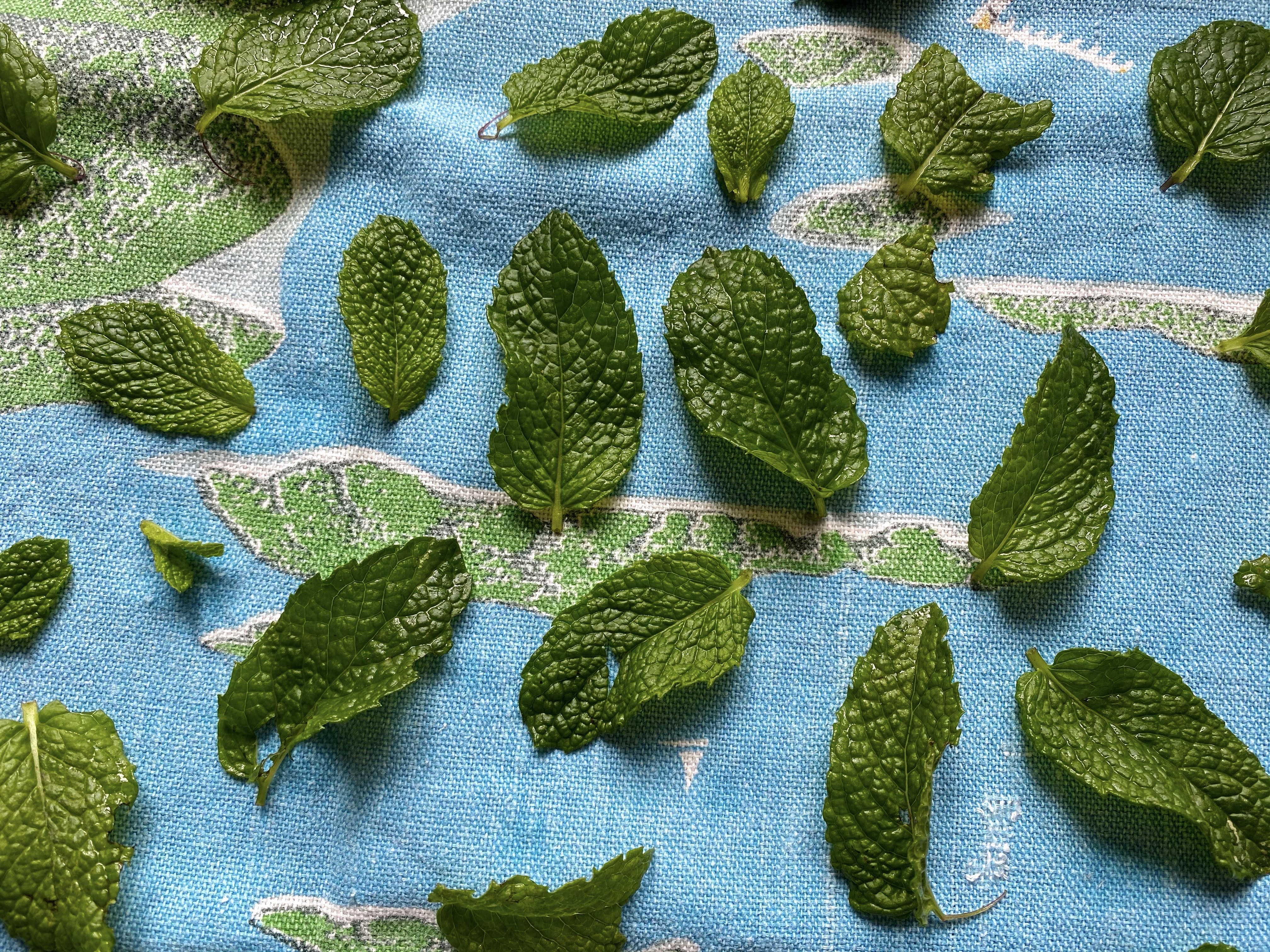
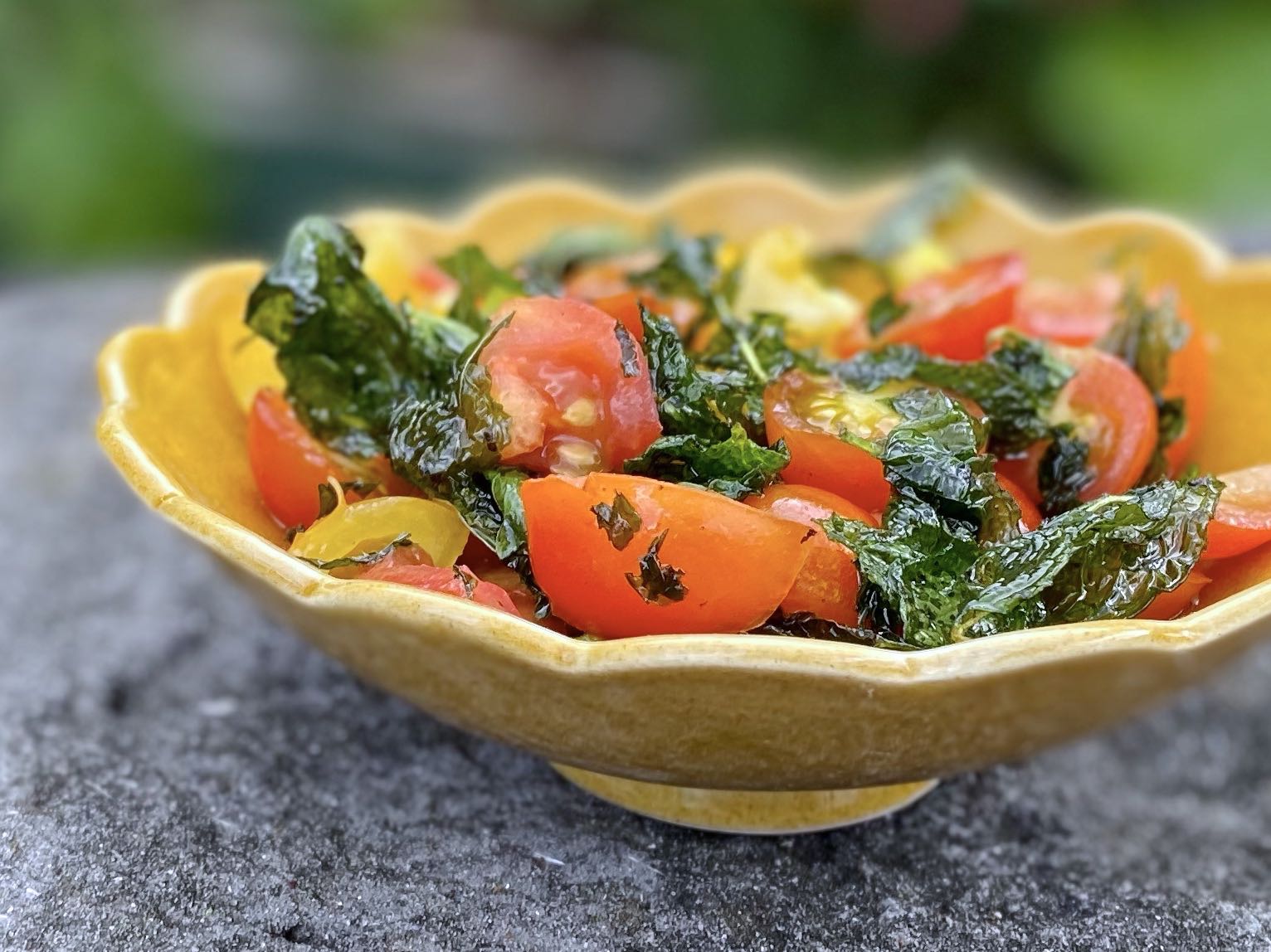
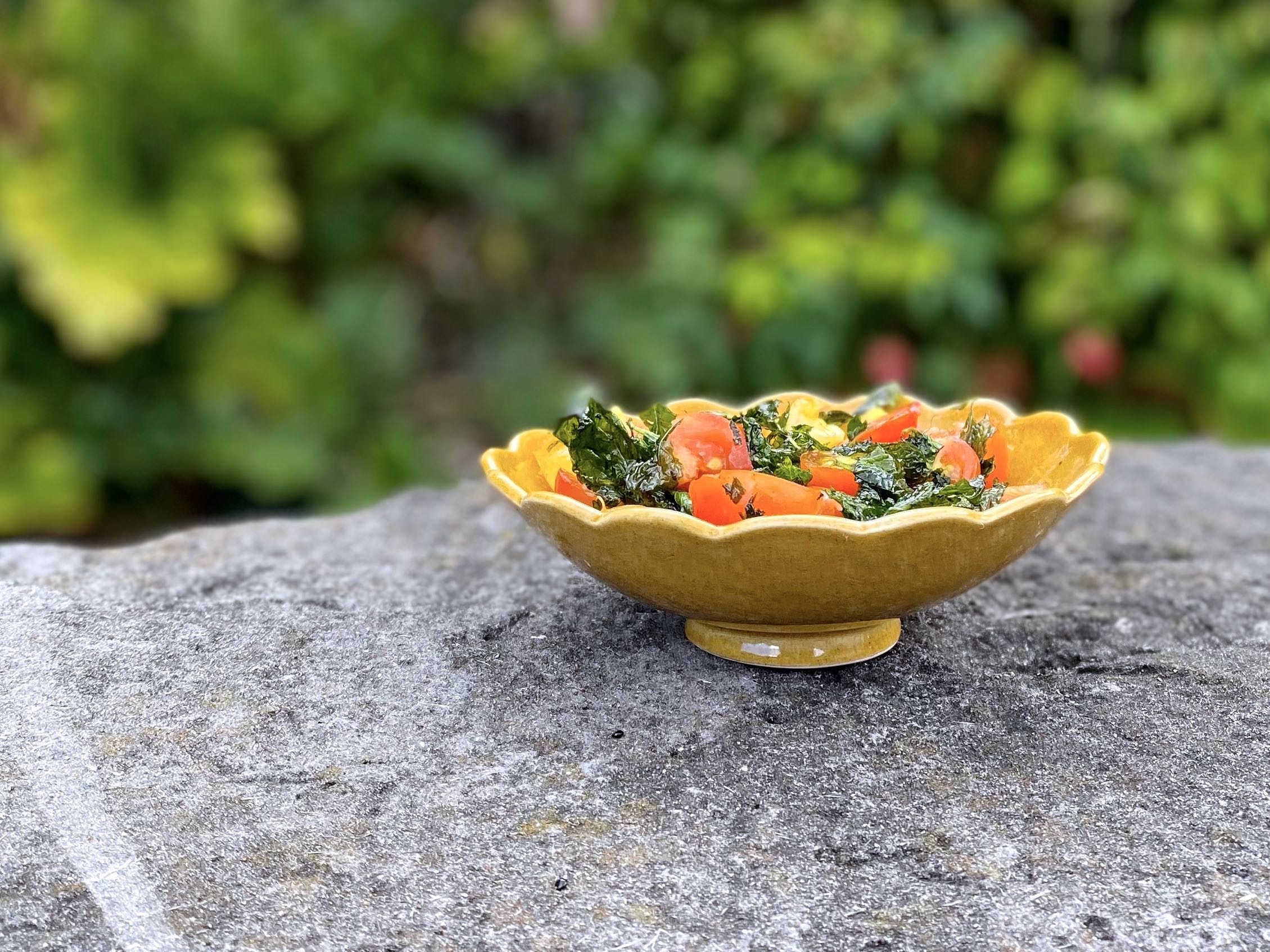
But what about the fried mint? You’d think, freshly chopped and stirred into tomatoes, it couldn’t be improved upon, but this is exquisite – the leaves grow translucent and as shatteringly crisp as filo pastry, their cool heat deepened and made more savoury, more lush. The leaves and their seasoned oil coat the tomatoes with a glossy slick of darkly fresh flavour – it’s sensational, it’s captivating.

Also – and I’m truly not going to do this every time – I made a little tiktok video to go with this. 

@hungryandfrozen

recipe for ya: tomatoes + fried mint 🍅 super simple and lush 🍃go to hungryandfrozen.com for more 🤠 #vegan #recipe #recipes #foodblog #summer #fyp

♬ Cheree – Suicide

This recipe, as I said, is really, really simple, and I just ate it alongside a short length of baguette – but as with anything tomato-based, it’s amenable to variety. Stir it through hot pasta for an instant sauce, pile it onto couscous and scatter with toasted seeds, add leaves and turn it into a salad, the usual ideas. You could also apply the fried mint and its oil elsewhere – for some reason I’m thinking ice cream, but obviously couscous and so on would benefit – but as it is, the red-and-green symphony (my final hyperbolic adjective I promise) of this recipe is perfect unadorned, eaten standing up in the kitchen because it’s so delicious you’ve forgotten to sit down.

IMG_6521

Tomatoes and Fried Mint

There’s hardly anything to this little salad – but it’s incredibly delicious – so here it is. Recipe by myself.

  • 1-2 handfuls ripe cherry tomatoes, depending on how much you want
  • 1 handful fresh mint leaves (roughly 15 leaves?)
  • 2 tablespoons rice bran oil or something similarly neutral like grapeseed or sunflower
  • 1 teaspoon extra virgin olive oil
  • salt to taste
  • 1/4 teaspoon malt vinegar, optional

1: Halve your tomatoes and place them in a bowl. If they need it, wash the mint leaves and pat them dry with a clean tea towel.

2: Heat the rice bran oil in a large saucepan and once it’s hot, throw in the mint leaves and cook them for a bare minute or so, stirring a little to coat them in the sizzling oil. Try to keep the leaves more or less in a single layer. I lifted a mint leaf from the pan and crumbled it in my fingers, its brittle, crisp texture was how I knew they were done. I don’t expect you to have the same cavalier attitude towards naked heat, but basically, these should be ready somewhere between thirty seconds and a minute in. Turn off the heat.

3: Spoon the mint leaves and their oil over the tomatoes. Add the extra olive oil and salt to taste. Stir. I also like to add a little ground white pepper, I can’t help it, I love the stuff. If you want to add the vinegar, here’s a good time – I like it both with and without, which I appreciate is not helpful for your decision-making.

Serves 1, possibly more, depending on how you’re using it. Don’t forget to drink the minty tomato juice which pools at the base of the bowl.

Notes:

  • If you don’t have access to a mint plant – and why should you – get one of those mini potted ones from the fresh herb section of the supermarket – the sort which are always overpriced and die almost instantly – and rip off every single leaf.
  • In case you’re wondering why there’s two oils, rice bran oil is better for frying, the dash of extra virgin olive oil at the end is for flavour, and not suited to high heat. I free-pour both and encourage you to do the same.

IMG_6509

music lately:

Blank Generation, by Richard Hell and the Voidoids. Is this the best song in the world? No, that’s Roadrunner by Modern Lovers. But also: yes it is. My methodology is watertight.

Bad Religion, Frank Ocean. This song is nearly ten years old (?!!) and yet it’s still too powerful! Like, imagine listening to this while walking down the street to buy toothpaste. There’s those opening church organs and those devastating, late-in-the-piece drums and that sudden falsetto howl, and suddenly you’re sobbing into a courier van, dental hygiene forgotten. Absolute folly.

A Boy Like That/I Have A Love by Chita Rivera and Carol Lawrence from the Original Broadway Cast recording of West Side Story. I’m always listening to Sondheim but since it was his birthday the other day I decided to listen to everything he’s done in chronological order, and twelve hours later I’d made it to…1957. Anyway – the film version of West Side Story is unsurprisingly what everyone thinks of first, but the original is also glorious – I love Chita’s throaty, knowing voice against Carol’s clear soprano, and those harmonies at the end are just stunning.

PS: If you enjoy my writing and wish to support me directly, there’s no better way than behind the claret velvet VIP curtain of my Patreon. Recipes, reviews, poetry, updates, secrets, stories, all yours on a monthly basis.

Fresh Peach Galette [Vegan]

IMG_4912

When pondering my blog recently, in the way a concerned parent might frown, with tented fingers, at their child’s blotchy and error-strewn schoolbooks, perhaps with unsavoury cartoons drawn in the margins, something occurred to me: the majority of my recipes lately have been baking, with the occasional preserve. The simple reason being I blog about things as I cook and eat them – it’s rare that I’ll make something especially for the blog – and in turn, baking is most likely to happen during the day, which makes for good photography light, as opposed to dinner, which either happens after the sun has set, or in a hurry of serving and eating, or both. As for desserts, which happen even later – well, no wonder I don’t have a ton of recipes for them these days. Unless they’re ice cream, a scoop of which can be photographed in the morning. I would love to have the kind of food blog where I make recipes – and even test them! – in the day time and photograph them specially, which would make it more of a resource, as opposed to in this incidental fashion with the photographing happening moments before the consumption. That’s not likely to change anytime soon, nor is it practical to my living situation, and that’s fine, but in case you’re like, “where are the dinner and dessert recipes already”, well, take comfort from the fact that I frequently lie awake thinking about that very same question.

IMG_4913

Anyway, this week I was the fortunate, grateful receiver of a large bucket of ripe peaches from my godmother’s garden, and I was determined to make something that wasn’t a cake or an ice cream (my first instinct, and – I’m not ruling out the remaining peaches ending up used in this fashion) but a dessert, a proper pudding. Enter this vegan peach galette – the ideal recipe for me, in that I could make it in the day, take some beautifully lit photographs, and then quickly warm it up later on for eating after dinner. And it’s the ideal recipe for you, because it’s a pie – but so much easier – with a careless and carefree method for pastry and filling both. And even though I’ve said it’s a dessert, in the unlikely event of leftovers a slice of this is lovely cold (or briefly nuked in the microwave) with a cup of tea or coffee.

IMG_4918

Untroubled by any other rowdy filling ingredients, the gorgeous peaches shine – lightly caramelised and jammy from the oven’s heat and gently helped along by the resiny warmth of the thyme leaves and a slight kick of lemon. The pastry couldn’t be easier – and yeah, it uses margarine, but let me be upfront: while I’m yet to meet a commercial margarine which doesn’t taste slightly awful either immediately, or later upon sober reflection in the middle of the night, I must concede that it’s a consistently well-behaved ingredient to bake with. Pastry is stressful enough without worrying about it falling to pieces! The margarine, plus the acid of the vinegar added to the milk, makes a pastry which is tender, easy to roll, extremely courteous, and bakes to a biscuity crisp finish. And to counteract the entirely valid stress of it tasting like margarine, I’ve added plenty of cinnamon – I promise, the finished product is purely peach pie, with no unwelcome flavours.

This galette would be beautiful with whatever fruit you have to hand – obviously any stone fruit could be subbed in, but also consider berries, apples, pears, or a thrilling combination of any of the above. But in our current high summer there’s no better fruit than the peach, and they look so gloriously golden and cosy peeking out from under their pastry blanket-hem that I’m almost envious of them – oh to be a peach, gently tucked under a fold of pastry and baked for thirty minutes!

IMG_4914

Fresh Peach Galette

An easy and delicious rustic free-form vegan peach pie, for anyone too scared to make a pie – the pastry is done in the food processor, the filling is basically just sliced peaches, and yet it tastes like so much more.
Recipe by myself. Makes six good-sized slices, or four even-better-sized slices.

  • 7 tablespoons margarine (no need to level them if they’re slightly heaped)
  • 2 cups plain flour
  • 1/2 cup soy milk
  • 1/2 teaspoon apple cider vinegar
  • 1 teaspoon cinnamon
  • 1/4 teaspoon salt
  • 5 ripe peaches
  • 1/4 cup sugar
  • 2 tablespoons lemon juice
  • 2 tablespoons custard powder
  • 1 teaspoon vanilla extract
  • 1 tablespoon fresh thyme leaves

1: Place the margarine and flour into the food processor bowl and – if it will fit – put the processor bowl in the freezer for ten minutes. If you don’t have the space, chill the margarine and flour in a small bowl before transferring to the food processor. While this is happening, mix the soy milk and vinegar together and set aside to activate/curdle.

2: Briefly blend the chilled margarine, flour, plus the salt and cinnamon in the food processor till everything is incorporated and resembles damp sand. Add the milk and vinegar mixture and pulse two or three times to just mix it in. Don’t worry if it’s not looking particularly coherent at this point, the key to a tender pastry is not over-mixing. Tip the dough into a bowl and press it into a ball with your hands. It’ll be a little sticky, which is fine, but dust a little more flour over if you think it needs it. Cover the bowl and chill the pastry in the fridge for about an hour, although you can leave it overnight if need be.

3: Once the pastry is about done chilling, set your oven to 190C/375F. Slice the peaches and place in a bowl with the sugar, lemon juice, custard powder, and vanilla.

4: Remove the pastry from the fridge and place on a baking paper lined baking tray. Roll it out to a large rough oval or circle shape – it truly doesn’t matter, just roll – about 1/2cm thick. I scattered a little flour on the dough and then put a piece of baking paper on top before rolling, both to prevent it sticking and to save having to wash the rolling pin, I recommend you do the same. The edges don’t have to be uniform, but if they’re particularly jagged, trim them a little, and re-roll the scraps of pastry into the rest of the dough.

5: Pile the peaches into the centre of the pastry, leaving a border of about 8cm free – no need to get out your ruler though, it really doesn’t matter too much either way, you just need to have enough free pastry to fold over the peaches.

6: Sprinkle the thyme leaves over the peaches. Fold the edges of the pastry over the peaches, as you can see in the photos. There should be some liquid remaining in the bowl which held the peaches – pour most of it over the peaches and use the rest to brush over the pastry (or you can simply brush the pastry with a little milk.) Bake your galette for thirty minutes, or until the pastry is golden and crisp. Let it sit for ten minutes before slicing.

Notes:

  • I say five peaches to account for any bruised bits/eating slices of peach as you go. If you have four absolutely perfect peaches and the fortitude to not eat any of them, you can use four. You could probably get away with three peaches, it would just be a smaller galette. And of course, you could use other stone fruit instead – nectarines, apricots, plums, etc.
  • If you don’t have a food processor – one less dish to wash, hurrah – simply rub the cold margarine into the flour with your fingertips, and stir the milk in with a spoon.

IMG_4916

music lately:

I Believe from the Broadway cast recording of Spring Awakening. I’ve been revisiting a lot of cast recordings I haven’t listened to in a long time and getting outstandingly emotional over them, thoroughly recommend it. That being said, I Believe could just about fool someone into thinking it’s not song from a stage show but instead a forgotten folk tune from the 70s, with its hopeful yet bittersweet refrain, yearning harmonies, and pensive guitar strumming.

Force Field by KŌTIRO from their album High-Def Multinational. This is just gorgeous, airy and spacious yet full and warm, like a freshly-baked loaf of bread. I also love the lush and immense Puti’s Maunga from the same album, it’s only 56 seconds long so my advice is to listen to it eighteen times in a row on loop to give yourself time to properly vibe with it.

PS: If you enjoy my writing and wish to support me directly, there’s no better way than behind the claret velvet VIP curtain of my Patreon. Recipes, reviews, poetry, updates, secrets, stories, all yours on a monthly basis.

Oat Butter, Two Ways: Homemade Vegan Oat Butter + Pecan Cookie Granola Butter

P1200115

Sometimes inspiration – not so much for recipes, but for the hunger that eventually drives their creation – comes from relatively ambient sources. And with COVID-19 things are getting more ambient and less direct every day. By which I mean, I saw someone tweet the words “oat butter” – I don’t even remember who it was or when, but as I was scrolling that pair of nouns really made themselves at home in the tastebuds of my mind and I knew, whatever oat butter was, I wanted it. I looked it up on google, and found two completely different culinary directions – first, a traditional table spread, based on actual butter, but made of oats, and second, a blended-to-smithereens peanut butter riff which promised to taste like cookies. I couldn’t decide which avenue sounded more appealing so – why not both? Two recipes it is.

P1200104

I’ve made several homemade butters before, with one based on ground almonds and one based on aquafaba and honestly? I love them all! Couldn’t choose between them. But there’s something about the rustic simplicity of the oats in this latest recipe, not to mention the recency bias, which appeals to me, and the resulting butter is stunning – rich, creamy, spreadable, light, delicious. Plus if you’re spreading it on wholegrain bread with oats in it, there’s the added deliciousness of synergy! It melts ably into a sauce to give added body (no surprise, with all that oil) and is equally at home under savoury or sweet toppings. I haven’t tried baking anything with it, mostly because it disappears so quickly. I wouldn’t rule out its working in this capacity, but homemade butters can behave differently to manufactured spreads so if you’re wanting to do this, I’d test it on something smallish and forgiving, as opposed to, say, your firstborn’s wedding cake for a union brought about to settle a generations-old blood feud.

If that weren’t enough synergy for you, there’s also the Pecan Cookie Granola Butter. It really does live up to its slightly overstuffed name, but I call it thusly for a reason: it simultaneously tastes like cookies AND granola, and pecans are expensive so I want anyone eating it to be super-aware of their presence. It’s made from a pulverised mixture of pecans, seeds, coconut and toasted oats, and you’ll curse my name as the food processor enters its fifteenth minute of noisy whirring with nothing to show for its efforts but pricey dust, but it does eventually come together, and upon tasting the finished product, you will forget the effort. It’s absolutely lush, nutty and oaty and dense and cinnamon-warm and delicious, and I’m so glad I found this recipe, as well as the other oat butter recipe, because my life has been genuinely improved by its existence. It’s one of those very America creations that I certainly wouldn’t have come up with it on my own (I mean I might have eventually, in a thousand-monkeys-thousand-typewriters way) and which sounds like there’s too much going on to process, but it makes perfect sense when you eat it.

Make one or both of these oat butters and – as well as the sheer thrill of experiencing synergy – your toast, instantly, will become a whole lot more exciting (which I say as someone quite easily diverted by toast, so hold onto your hats, I guess.)

P1200107

Oat Butter

A rich, buttery spread for your toast, sandwiches, and sauces, and it’s pretty much entirely made of oats? Amazing. This recipe comes from tastecelebration.com, I have made some slight adaptations, but otherwise it’s all theirs.

  • 500ml/2 cups water
  • 3/4 cup rolled oats
  • 2 tablespoons rice bran oil or other neutral oil (eg sunflower)
  • a pinch of salt, plus more to taste
  • 1/2 cup refined coconut oil, melted but not hot
  • 1/2 cup rice bran or other neutral oil, extra
  • 1 heaped teaspoon white miso paste
  • Scant 1/4 teaspoon sugar (optional – I think it improves the flavour but up to you)
  • a pinch of turmeric, for colour

1: Bring the 500ml water to the boil in a small saucepan. Stir in the oats, remove from the heat, and leave to sit for half an hour.

2: Pour the oats and liquid into a high-speed blender with the 2 tablespoons oil and a pinch of salt, and blitz until very smooth, pale, and creamy. Now, you CAN strain this through a cloth or a nut milk bag or whatever but I literally just used a regular kitchen sieve and I was pleased with the results so don’t feel you have to rush out and buy equipment. Whatever you end up using, strain this liquid into a container – there shouldn’t be much ‘grit’ left behind, but this step will make it especially smooth. You only need half a cup of this oat cream to make the butter – store the rest in the fridge and add it to sauces, soups, or anything you want to make more rich and creamy.

3: All you have to do now is blend 1/2 a cup (125ml) of the above oat cream, along with the second measure of rice bran oil, the melted coconut oil, the miso paste, a tiny pinch of sugar, and salt to taste, until it’s smooth and thick. No need to wash the blender!

4: Taste to see if it needs a little more salt and then spatula it into a clean jar or airtight container and chill in the fridge until firm.

Makes around 325ml. Consume within a week.

Notes:

  • Refined coconut oil is important here so the butter doesn’t taste overwhelmingly coconutty – that being said I’m sure it’ll still taste good so if you don’t mind the coconut vibe and all you have is unrefined coconut oil, go ahead.
  • If you don’t have a high speed blender, a stick/immersion blender will do the trick. You could try using a regular food processor, you just might need to blend the oats and water together for a bit longer. I’m afraid it’ll be very difficult without some kind of equipment, as is the case for most vegan recipes it seems!

P1200113

Pecan Cookie Granola Butter

This is SO GOOD and worth the hectic endless blending – instead of a spreadable butter, this is in the peanut butter family of spreads, blitzing toasted oats, nuts and seeds into an incredibly delicious spread which tastes like melted cookies, if that were a thing. Recipe adapted a little (and gratefully) from this one at foodfaithfitness.com.

  • 1 and 1/2 cups rolled oats
  • 3/4 cup pecans
  • 1/2 cup sunflower seeds
  • 1/2 cup pumpkin seeds
  • 1/2 cup coconut chips/flakes
  • 1/3 cup coconut oil (either refined or unrefined is fine here)
  • 4 tablespoons golden syrup or maple syrup
  • 2 teaspoons cinnamon
  • 2 teaspoons vanilla extract
  • pinch salt

1: Place the oats in a large frying pan and stir them over a low heat for about five minutes to lightly toast them – you don’t want them scorched, but a little golden and browned in places is good. As soon as they hit this stage, and you can smell their fragrance wafting up to you, remove the pan from the heat and transfer the oats into the bowl of a food processor.

2: Place the pan back on a low heat and tip in the pecans, sunflower seeds, and pumpkin seeds, stirring over a low heat for a couple of minutes until they are fragrant and warmed through. Transfer them to the food processor with the oats, and finally, toast the coconut chips for a minute or so until lightly browned in places – this won’t take long at all. If you’re feeling reckless/impatient you can toast the whole lot at once, oats and nuts and everything, bearing in mind that the coconut will toast quicker than anything else.

3: Blend these ingredients on high for about fifteen minutes, stopping every now and then to scrape down the sides with a spatula and to give your processor’s motor a break. Nothing will happen for ages – it’ll just look like rubble – but eventually, if you keep blending for ages and ages and ages – the nuts, seeds and coconut will release their oils and it’ll suddenly start to look more promising and like a potential spread. But you really just have to keep blending and blending and blending, much longer than feels right, and I’m sorry in advance!

4: Once it gets to this point, add the remaining ingredients and continue blending for another five to ten minutes until it’s a thick paste that vaguely resembles almond butter. Taste to see if it needs more salt, sugar, or cinnamon (I usually end up adding more of each for what it’s worth) and then spatula it into a jar and store in the pantry.

Makes around 250-300ml (It really feels like it should make more, but all that blending really minimises and compacts the structure of its ingredients.) (Sorry.)

Notes:

  • You can muck around with proportions and ingredients here – pecans have a specific flavour which seems to evoke cookies, so I wouldn’t want to make it without them, but I’m sure walnuts would have their own charm instead.
  • You can toast the nuts and seeds etc in the oven, which will result in more even toasting, but I prefer the speed and ease of the stovetop method. Either way, keep a close eye on them.
  • The original recipe asks you to blend the nuts and seeds first before adding the coconut and oats and I probably should have done that too, but I read the recipe in a heedless fashion and just blended everything together all at once. As you can see, it worked out fine, but I still feel like I should tell you and you can definitely choose this option instead! Probably to your benefit!

P1200118

music lately:

A Man Without Love by Robert Goulet. That chorus! So boisterously mournful! I listened to this forty times in a row on loop on Friday and look, I turned out fine!

You’re No Good by ESG, minimalist yet stroppy with a delightfully cunning bassline.

A Love From Outer Space, by A.R Kane. Yes, them again, I just love them!

Lonely Room from the soundtrack to The Apartment by composer Adolph Deutsch. I’ve been listening to a LOT of old film scores lately which is, if you’re similarly inclined, an excellent way to make one’s COVID-restricted life feel slightly more glamorous. The Apartment is one of my very favourite films and its score is just heavenly – as demonstrated in this track which is somehow sorrowful yet immensely comforting at the same time.

Next time: I feel like I haven’t done anything savoury in ages BUT I also made an incredible passionfruit panna cotta, so! The sugar rush continues.

PS: If you enjoy my writing and wish to support me directly, there’s no better way than behind the claret velvet VIP curtain of my Patreon. Recipes, reviews, poetry, updates, secrets, stories, all yours on a monthly basis.

Roasted Plum Harissa [Vegan]

P1200197

We’re still squarely in Plumtown. Last time it was the Five-Spice Plum Ice Cream, this time it’s Roasted Plum Harissa, an idea inspired by Nigella Lawson’s apricot harissa from her latest book, Cook, Eat, Repeat, which I joyfully received for Christmas. This book is exactly what I needed – not a cookbook as you’d expect it, but just an unhurried and welcome tidal wave of Nigella meditating with gentle persistence on food and its place in our lives. It’s honestly near-hypnotic.

Cook, Eat, Repeat, is the first post-COVID cookbook I’ve read – more specifically, it’s clear that the pandemic affected the course of the book, as Nigella talks about changing a chapter on dinner parties and offers several means of reducing recipes down to a single serve. It’s not as simple as merely, breezily, omitting content however. When she says, in the Christmas chapter – a time of year she has made very much her province in all its elaborateness – that as long as she had her children around the table that year she could “eat gruel and be happy” – when she says “we shall not be eating in isolation forever,” – well! Let’s just say the cookbook got stained with tears before it did with cooking ingredients. (I mean, it took me precisely one recipe to stain the book with ingredients, and as you can probably guess the contents of this harissa are also living on, pagebound.) I sometimes feel weird and ungracious barrelling on with blogging as though everyone reading this is in the same, relatively calm position I’m in – I also can’t rule out New Zealand unexpectedly entering another lockdown at any minute. Nigella, as per usual, is excellent at articulating not just the food, but every emotion and motivation and expectation and context around the food – and there is just so much to articulate!

IMG_4403

Anyway, the harissa. Nigella acknowledges that apricots aren’t traditionally used in this Tunisian chilli paste, and as for plums, well, they’re really not supposed to be there. But I couldn’t stop thinking about them together with the chillies and spices – possibly from the power of suggestion as opposed to culinary genius as we just had so many plums around – but either way, this harissa is lush, and for that, at least, I comfortably give myself credit. That plummy taste – you know, garnets soaked in pinot noir, something like that – plus their sourness, softened by the heat of the grill, is tremendous with the blistered chillis and all those whole spices – licorice-y caraway, smoky paprika, earthy cumin, and ginger-lemony cardamom and coriander. The combination of heat and spice, plus the sweetness, saltiness, and the richness of the olive oil, is incredibly compelling – you’ll taste it to see if it’s balanced and find your spoon returning again and again to the bowl without even realising it.

This harissa is immensely versatile – first of all, you can just use it wherever you might otherwise have applied some kind of chilli. It’s wonderful alongside tomato – the acid of the plums and the depth of the spices making the blandest, cheapest canned tomatoes come alive – and I’ve used it already in a tomato-based pasta sauce and a sort of patatas bravas-type dish with great results. It also works to punch up more mellow foods – for example, it would be delicious alongside or inside hummus, and in Cook, Eat, Repeat, Nigella uses her apricot harissa in a roasted cauliflower recipe – I’m sure I’ll be following her lead before long. For all of harissa’s versatility, we’re likely to move through most of it just from me swiping spoonfuls from the jar every time I pass through the kitchen, in fact, I’ve half a mind to spread it on my toast.

P1200200

Roasted Plum Harissa

Spicy, sour-sweet, extremely compelling. Recipe based closely on the Apricot Harissa from Nigella Lawson’s wonderful book, Cook, Eat, Repeat.

  • 6 ripe, firm plums
  • 3 large red chillis
  • 2 tablespoons olive oil
  • 1 teaspoon caraway seeds
  • 1 teaspoon coriander seeds
  • 1 teaspoon cumin seeds
  • seeds from 4 cardamom pods
  • one teaspoon ground turmeric (or 15g fresh, peeled and roughly chopped)
  • 25g fresh ginger, peeled and roughly chopped
  • 4 cloves garlic, peeled
  • 2 teaspoons sea salt flakes, or to taste
  • 1 teaspoon sweet smoked paprika
  • 1 tablespoon coconut sugar (or regular sugar)
  • 6 tablespoons olive oil, extra
  • 1 teaspoon apple cider vinegar

1: Turn your oven to the grill (broil) function at 220C/425F. Slice the plums in half, discarding the stones, and place the fruit cut side up along with the chillis in a small shallow roasting dish. Pour over the two tablespoons of olive oil, turning the plums and chilli over and back again with your hands to make sure they’re all oil-slicked. Grill for about ten minutes, or until the chillis are wrinkled and darkened in places. The plums should still be holding their shape but look a little collapsed.

2: Remove everything from the oven. Place the chillis in a small bowl and cover with plastic wrap or something airtight and more environmentally friendly should you have it, and set aside for a few minutes. This will make it very easy to peel the skin from the chillis – which is the next step – although it doesn’t matter if some skin remains. Discard the green stems from the chilli, and if you want a more mellow harissa you can pull/prise open the chillis and remove the seeds at this point, too. Make sure to wash your hands thoroughly afterwards and avoid touching your eye area, as any chilli remaining on your fingertips will hurt like hell.

3: Place the deseeded, skinned chilli back in the small bowl along with the plums and any oil from the roasting dish (a spatula is useful here.) Place the caraway, coriander, cumin and cardamom seeds in a small pan and toast them over a low heat for just a minute or two, shaking the pan and stirring them to ensure they don’t burn. Their fragrance should, as Nigella says, waft up to you as they cook – this will let you know it’s time to remove them from the heat. Tip these spices into the bowl of chillis and plums.

4: Add the remaining ingredients to this bowl, and using a stick blender, blitz it to a bright-red, smooth-ish paste. Taste to see if it needs more salt, or maybe a dash more vinegar or sugar – you may also want to add more olive oil. You’ll know when you have the harissa you want.

5: Transfer this mixture to a clean jar, and store in the fridge. It may solidify or separate slightly after a while in the fridge, but a brisk stir will set it right again. I don’t know how long it keeps, to be honest, but I imagine pretty indefinitely.

Makes 250ml/1 cup.

Notes:

  • You can of course use Nigella’s originally stipulated dried apricots (six thereof) instead of plums. She also used 20g large dried chillis, reconstituted in boiling water, and the only reason I didn’t use them was because I absolutely couldn’t find any at my local supermarket. The sugar is also my addition, to balance the sourness of the plums – dried apricots wouldn’t need such sweetening.
  • If you use five or seven plums and four chillis or whatever I doubt it’ll hurt the recipe – you’ll just end up with slightly more or slightly less harissa.
  • If you don’t have sea salt, I would just add whatever salt you have a little at a time until the salinity suits your taste buds.
  • If you don’t have a stick blender, then a regular smallish food processor should do the trick, but maybe bash the spices in a pestle and mortar first or put them through a spice grinder (although if you have such fancy equipment as this you probably have a stick blender.) You could also surely make this whole thing in the pestle and mortar if you’re so inclined.
  • You might notice that the plums are actually grilled, not roasted, but I thought the word roasted sounded better, and then also it cuts out the potential cross-translation into the American word “broil”, which I just think sounds kind of terrible, comparatively. So, roasted it is.

P1200204

music lately:

Joy by Apollo 100. You may sneer, but five seconds of listening to this sheer exuberance will have you dancing an eightsome reel before your mind has even had time to process what your body is doing. The hymn Jesu Joy of Man’s Desiring, upon which this is based, is one I sang with negligible success in my school choir – and which I erroneously believed, until this year, was also sung by Dame Kiri Te Kanawa at the wedding of Princess Diana. The choir teacher told us this, possibly to motivate us to be less visibly tormented by that laborious time signature. The whole time, Dame Kiri actually sang Let The Bright Seraphim. This is exactly like the time I realised, after telling so many people that Rita Moreno was the first person to get an EGOT, that Rita Moreno was not the first person to get an EGOT.

A Depression Glass, by Spahn Ranch. Holds onto some of their earlier “chainsaw being thrown at your head” vibe while sounding extremely 1997 – in fact it sounds like it could have been in the party scene in the film Nowhere by Gregg Araki, which is one of the higher honours I could bestow a song.

Ridin’ For A Fall from the 1943 film Thank Your Lucky Stars, performed by Dennis Morgan and Joan Leslie (although, actually dubbed by voice-for-hire Sally Sweetland.) That “gal with the big blue eyes” line is astonishingly catchy, and although it’s not her singing voice, Ms Leslie’s charisma and good humour is so evident in every frame, I just love it. If I’m honest, I think they could’ve chosen a more relaxed vocal for this number – Ms Sweetland’s soprano is beautiful, but it sounds a little overcooked in this cutesy song. Someone with a more conversational tone, like say, Annette Warren (who provided the singing voices for Ava Gardner and Lucille Ball among others) might’ve been better. Even so, Joan Leslie sells it 100%.

Next time: I’m making cupcakes for my dad and brother’s birthday, I’m assuming they’re going to be delicious and so will share the recipe here.

PS: If you enjoy my writing and wish to support me directly, there’s no better way than behind the claret velvet VIP curtain of my Patreon. Recipes, reviews, poetry, updates, secrets, stories, all yours on a monthly basis.

Spaghetti with Olives, Nori, Pine Nuts and Chilli

P1190753

Not once in my thirteen years of writing hungryandfrozen.com has a recipe featured anchovies. I wasn’t against anchovies — I also clearly wasn’t going out of my way to court their flavour. Being vegan now would suggest that stance is unlikely to change, but then I re-read a Nigella Lawson cookbook, as smooth and eroded from my fingerprints as a statue of Mary in a particularly tourist-friendly French cathedral, and suddenly I was consumed with trying to capture the flavour of anchovies — minus the anchovies. You might shrewdly ask, where was this fervour over the last thirteen years? The thing is, I’ve already had my first Nigella-fuelled attempts at an anchovy phase back in 2006, just before I started my blog. It wasn’t successful — I don’t think I’d amassed the life experience needed to truly enjoy anchovies — and it had since lain dormant, waiting for the trigger: the fact that I really can’t eat them anymore, and so of course, strangely want them. Limitation being the mother of invention — and Nigella being the mother of the mother of my invention — which I guess would make me the mother of my own limitation, and my limitation a servant of two masters, and this paragraph complete nonsense — I made this spaghetti.

P1190759

As they say when they’re quoting The Wire, all the pieces matter — the olives give briny density, the nori sheets strongly suggest the ocean, the pine nuts are gently rich, the parsley is strident and a little astringent, and the prunes add darkly subtle balancing sweetness without any actual, you know, pruniness. I know prunes are deeply un-alluring but I insist that you humour me here! I’ve previously paired them with olives in my tapenade recipe – frankly, I think they’re an ideal match for each other’s intensity. The chilli flakes were a reckless, “more is more” addition, but their heat grounds the sauce, stopping the flavour from skidding too wildly off-course.

The flavour of this sauce is A Lot, and it looks completely hideous — like hearty mud — but once you’ve made peace with both these factors, deliciousness awaits you. Because, A Lot of flavour is great! And the ugliness of the pasta can be carefully hidden under parsley and extra pine nuts, as you see in the photos. It would take someone more recently familiar with those tiny fish than I to assess for sure if this captures the flavour of anchovies, but it’s definitely got a vibe, you know? This is pasta that has known the sea.

Given that this was inspired by her numerous anchovy-pasta recipes I probably should’ve given it a Nigella-esque high kick of a name, but I find it more helpful for all involved to simply list the main star ingredients. (Pointedly, minus the prunes, since I don’t want to alienate people before they’ve even begun.) That style works for Nigella — no-one needs to read me calling something “Sprightly Spaghetti.”

(To be fair, it really is sprightly.)

P1190755

Spaghetti with Olives, Nori, Pine Nuts and Chilli

A recipe by myself

  • 1/2 cup pine nuts (70g)
  • 3/4 cup black olives, pitted
  • 1/2 cup parsley (more or less – just grab a handful)
  • 2 x 10cm nori sheets, or to taste
  • 1/4 cup olive oil
  • 2 garlic cloves or to taste
  • 2 prunes
  • chilli flakes, to taste
  • 100g spaghetti or pasta of your choice

1: Toast the pine nuts in a small pan over a medium heat till they’re lightly browned. Reserve a tablespoon or so for sprinkling over at the end, if you like, along with a little of the parsley.

2: Blend the pine nuts, olives, parsley, nori sheets, olive oil, prunes, and chilli flakes either using a stick blender in a small bowl (which is what I did) or in a small food processor, until it forms a thick paste. You will probably need to scrape down the sides once or twice. Taste to see if you think it needs more chilli, nori, etc.

3: Bring a pan of well-salted water to the boil (or, more efficiently, boil the jug and then pour that into the pan along with your salt) and cook the spaghetti for ten to twelve minutes, or however long it takes for them to be done.

4: This is a good opportunity to steal some of the pasta cooking water to stir into the olive paste to make it more saucy, if you like – around quarter of a cup should do it. The starch from the pasta makes the cooking water particularly great for this purpose, as opposed to plain tap water which will just make it watery.

5: Drain the pasta, stir through as much of the olive sauce as you like, and sprinkle over more parsley, chilli flakes, and the reserved pine nuts to serve.

Serves 1 generously, and the sauce would easily stretch to two people, just double the pasta obviously. If you don’t have a blending implement, you could chop all the sauce ingredients as finely as possible and mix them together — it will be a lot more textured as opposed to saucy, but this isn’t a bad thing!

P1190761

music lately:

All Through The Night, Cyndi Lauper — one of the most beautiful pop songs. My introduction to this was via a 2002 Idina Menzel concert bootleg at Ars Nova (if you know, you know!) but Lauper’s original is glorious, with those delicious twinkly keys and that reckless, triumphant, anything-is-possible chorus.

Suddenly Seymour by Ellen Greene and Rick Moranis, from Little Shop of Horrors. There is no one else on earth who should sing this but Ellen Greene — the way she goes from that feather-squeak speaking voice to a blood-freezing full belt is astonishing. I love the way the verses rush over each other in the middle section, I love the Kermit (as in, the Frog) earnestness of Moranis’ voice, and — Ellen Greene’s belting! So exhilarating.

PS: If you enjoy my writing and wish to support me directly, there’s no better way than behind the claret velvet VIP curtain of my Patreon.